Patients on lecanemab did better when their caregivers felt more positive about caring
Caring for someone with dementiaPart of a story we are following · 3 articles · See every update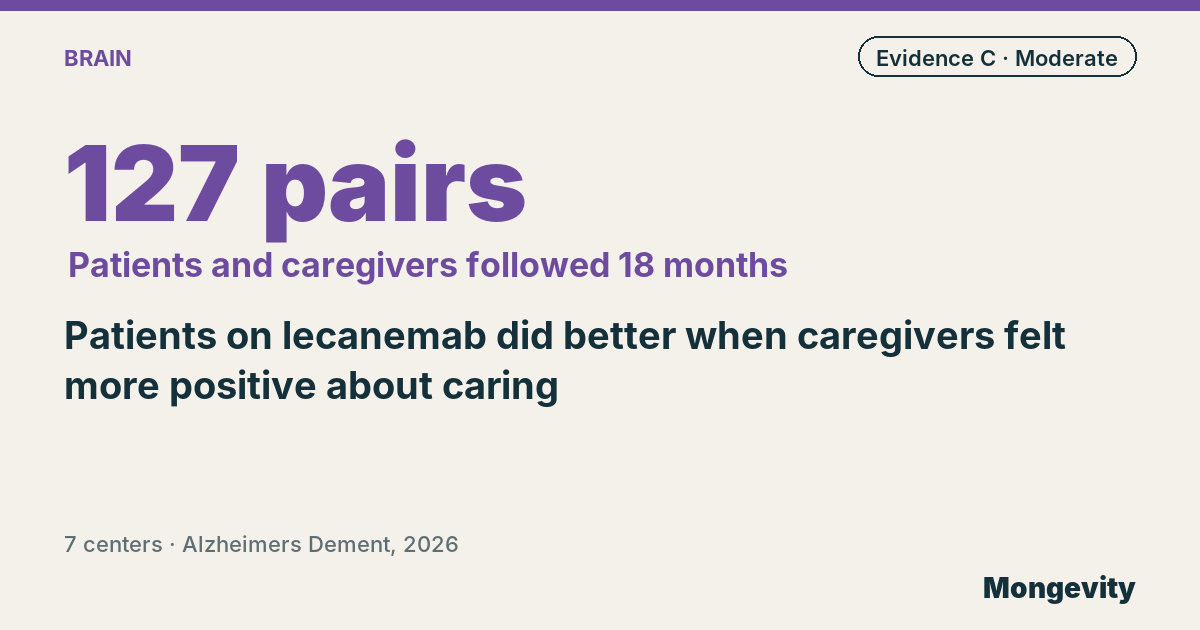
Caregivers’ positive view of caregiving was linked to better 18-month outcomes in cognition, daily function and quality of life for patients on lecanemab, in a study of 127 patient-caregiver pairs in China published in October 2026 in Alzheimer’s & Dementia. Support for dementia caregivers may also help patients.
Caring for someone with Alzheimer’s is demanding, but many caregivers also find meaning, closeness or pride in it. Researchers call this caregiver positivity. Could the caregiver’s outlook affect how the patient does?
What did the study do?
At seven centers in China, researchers followed 127 pairs of patients with biomarker-confirmed Alzheimer’s and their caregivers for 18 months. Caregivers filled in the Positive Aspects of Caregiving scale at the start. The team then compared patients’ outcomes over time.
What did the study find about dementia caregivers?
Higher caregiver positivity at the start was linked to better 18-month outcomes in:
| Patient outcome | Association with caregiver positivity |
|---|---|
| Cognition (MMSE) | Better (β 0.42) |
| Daily function (ADCS-ADL) | Better (β 0.68) |
| Disease severity (CDR-SB) | Lower (β -0.26) |
| Quality of life | Better (β 0.53) |
| Apathy | Lower (β -0.09) |
These links held after correcting for multiple comparisons. Patient quality of life showed the most consistent link.
Why does this matter?
The study suggests that the caregiving relationship may shape how patients fare on treatment. Assessing and supporting caregivers could become part of Alzheimer’s care, not an afterthought. Caregivers also carry a heavy load of stress and fatigue, so supporting them may help both people in the pair, at home and in the clinic.
How solid is this evidence?
It’s limited. Mongevity rates it C on our A-to-E scale: a multicenter longitudinal study with careful statistics, but observational and modest in size. Caregivers may feel more positive precisely because the patient is doing better, so the direction of the link is unclear.
What are the open questions?
Trials are needed to test whether programs that support caregivers and foster positive aspects of caregiving improve patient outcomes.
What does this mean for you?
If you care for someone with dementia, your well-being matters for both of you. Look for caregiver support groups, respite care and moments of connection with the person you care for. Ask the care team about resources for caregivers.
How do I explain this at dinner?
In people with Alzheimer’s getting a new drug, those whose caregivers found more meaning in caregiving had better memory, daily function and quality of life 18 months later. It’s not clear which came first. A good question for the table: who cares for the caregivers?
In one sentence: caregiver positivity was linked to better 18-month outcomes in patients with Alzheimer’s on lecanemab, supporting caregiver-inclusive care.
Questions and answers
- What is caregiver positivity?
- The positive aspects caregivers find in caregiving, such as meaning, closeness or pride.
- What was it linked to?
- Better 18-month cognition, daily function and quality of life in patients on lecanemab.
- Does it prove caregivers cause better outcomes?
- No: patients doing better may also make caregivers feel more positive.