As cats age, their urine changes more than their blood, pointing to the kidneys
Senior catsPart of a story we are following · 3 articles · See every update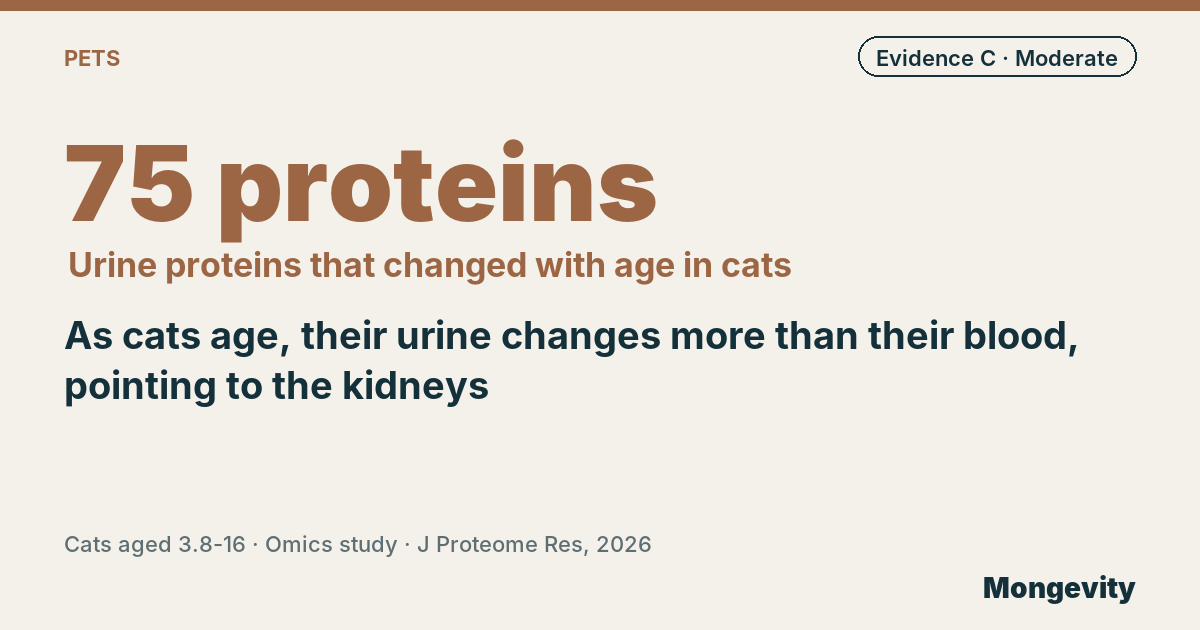
Seventy-five urine proteins changed with age in cats aged 3.8 to 16 years, many linked to kidney disease and high blood pressure, while only six blood proteins differed, in a study published in September 2026 in Journal of Proteome Research. For senior cats, urine may be an early window into aging.
Cats are living longer, and aging brings common problems such as kidney disease, high blood pressure and cognitive decline. Finding early markers of these changes could help catch them sooner.
What did the study look at?
Researchers analyzed serum (the liquid part of blood) and urine from domestic cats aged 3.8 to 16 years, grouped as adult, old and senior. They used proteomics, which measures many proteins at once, and lipidomics, which measures fats, to see which molecules change with age.
What did the study find about senior cats?
- They identified 901 proteins in urine and 238 in blood.
- 75 urine proteins changed significantly with age; many are linked to kidney disease, high blood pressure, brain degeneration and metabolic problems.
- Only six blood proteins differed between adult and older cats, including lower apolipoprotein A-I in seniors, a protein linked to cognitive function.
- In blood, some fats such as triglycerides, phosphatidylcholines and sphingomyelins increased with age; urine fats changed less.
Why does this matter?
Urine is easy to collect and, in cats, seems to reflect aging, especially of the kidneys, more clearly than blood. In the future, urine-based panels might help veterinarians spot age-related problems earlier. Cats may also serve as a model for human aging, since they share our homes and environment.
How solid is this evidence?
It’s early. Mongevity rates it C on our A-to-E scale: a detailed observational laboratory study in naturally aging cats. Limits: it compares cats of different ages at one point in time, the abstract doesn’t give the number of cats, and the findings are exploratory, not tests ready for clinical use.
What are the open questions?
Studies following the same cats over years are needed to see whether these urine changes predict disease, and to turn them into practical tests.
What does this mean for you?
For now, the best tools are regular veterinary checkups for older cats, including urine and blood tests and blood pressure measurement, usually at least once a year after middle age. Watch for more thirst or urination, weight loss or behavior changes.
How do I explain this at dinner?
Scientists compared the urine and blood of young and old cats. Many proteins in the urine changed with age, especially ones tied to the kidneys and blood pressure, while blood barely changed. A cat’s urine may be an early window into how it’s aging. A good question for the table: what signs would tell you a pet is getting old?
In one sentence: in naturally aging cats, urine showed many more age-related protein changes than serum, many linked to kidney disease and hypertension.
Questions and answers
- What did the study measure?
- Thousands of proteins and fats in urine and blood of cats aged 3.8 to 16 years.
- What changed most with age?
- Urine: 75 proteins changed, many linked to kidney disease and high blood pressure.
- And blood?
- Only six proteins differed, including lower apolipoprotein A-I in seniors.
- Is there a new test?
- Not yet; the findings are exploratory.