Pneumonia vaccines worked better in people on dialysis than in kidney transplant patients
Living with dialysisPart of a story we are following · 4 articles · See every update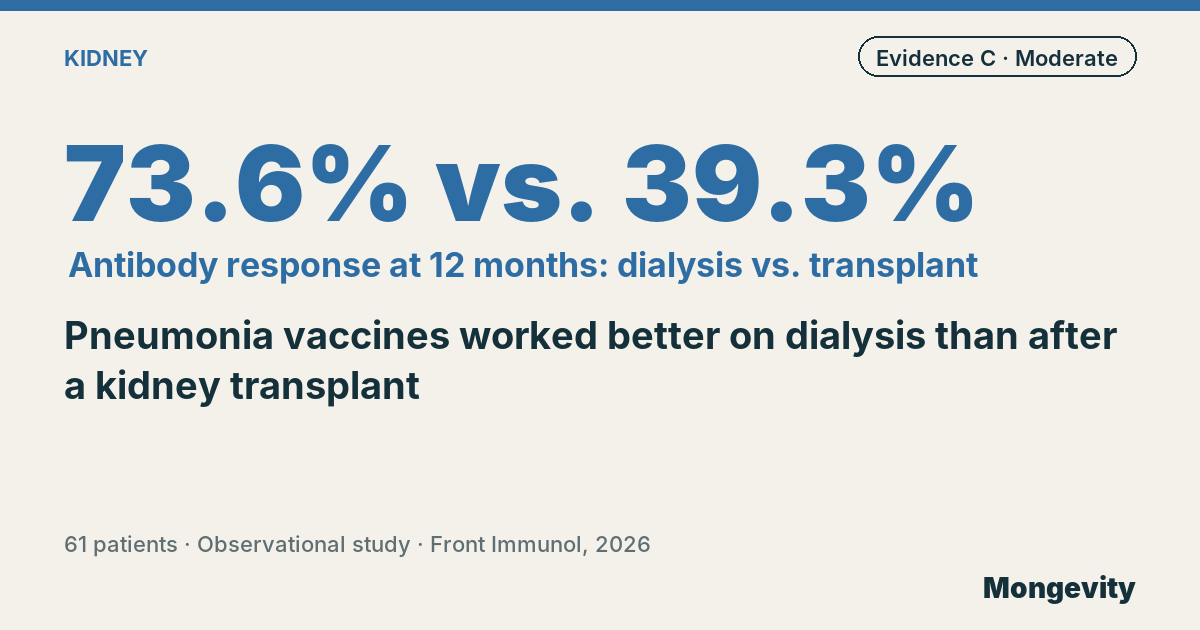
A two-step pneumococcal vaccine schedule produced a global antibody response in 73.6% of dialysis patients at 12 months vs. 39.3% of kidney transplant recipients, in a study of 61 people with kidney failure at one center, published Oct. 8, 2026, in Frontiers in Immunology. People on dialysis responded better, but transplant patients may need extra protection.
Pneumonia is the second most common infection in people with end-stage kidney disease, and it often has serious consequences. The bacterium most often responsible is Streptococcus pneumoniae, or pneumococcus, which vaccines can help prevent. But kidney failure, and the immune-suppressing drugs used after a transplant, can weaken vaccine responses.
What did the study do?
At a single center, researchers followed 61 people, 30 on dialysis and 31 with a kidney transplant, who received a standard schedule: one dose of a 13-valent conjugate vaccine followed 2 months later by one dose of a 23-valent vaccine, between 2015 and 2016. They measured antibodies against 7 pneumococcal types before each dose and at 3, 6 and 12 months.
What did the study find about dialysis?
| Global antibody response | Dialysis | Kidney transplant |
|---|---|---|
| At 3 months | 62.2% | 32.3% |
| At 6 months | 73.6% | 35.5% |
| At 12 months | 73.6% | 39.3% |
Antibody levels and rates of response were generally higher in people on dialysis, except for three of the seven types. Overall, the authors describe the response as modest.
Why does this matter?
Transplant recipients take drugs that dampen the immune system to protect the new kidney, which also blunts vaccines. These results support vaccinating people with kidney disease before a transplant when possible, and suggest that recipients may need closer follow-up or different strategies.
How solid is this evidence?
It’s moderate. Mongevity rates it C on our A-to-E scale: a careful antibody study with repeated measurements, but small, at a single center, observational and from 2015-2016. It measured antibodies, not actual pneumonia cases, and newer pneumococcal vaccines are now available.
What are the open questions?
It remains to be tested whether newer, broader conjugate vaccines or booster doses work better for transplant recipients, and whether antibody levels translate into fewer infections.
What does this mean for you?
If you or someone close to you has advanced kidney disease, is on dialysis or is waiting for a transplant, ask the care team which pneumococcal vaccines are recommended and when, ideally before the transplant. Flu and COVID vaccines matter too.
How do I explain this at dinner?
People with failing kidneys are at high risk of pneumonia. A two-step vaccine produced protective antibodies in most people on dialysis, but in fewer than half of those with a kidney transplant, whose immune systems are deliberately calmed. A good question for the table: why might it be better to vaccinate before a transplant?
In one sentence: a two-step pneumococcal vaccine schedule produced a modest response overall in kidney failure, stronger in people on dialysis than in transplant recipients.
Questions and answers
- Why do people with kidney failure need pneumonia vaccines?
- Pneumonia is common and serious in end-stage kidney disease, and pneumococcus is the main cause.
- Did the vaccines work?
- The response was modest: 73.6% of dialysis patients and 39.3% of transplant recipients responded at 12 months.
- When is the best time to vaccinate?
- Ideally before a transplant, since immune-suppressing drugs weaken vaccine responses.