Volunteers given a weakened dengue virus showed how past immunity shapes infection
Infections and vaccines after 50Part of a story we are following · 9 articles · See every update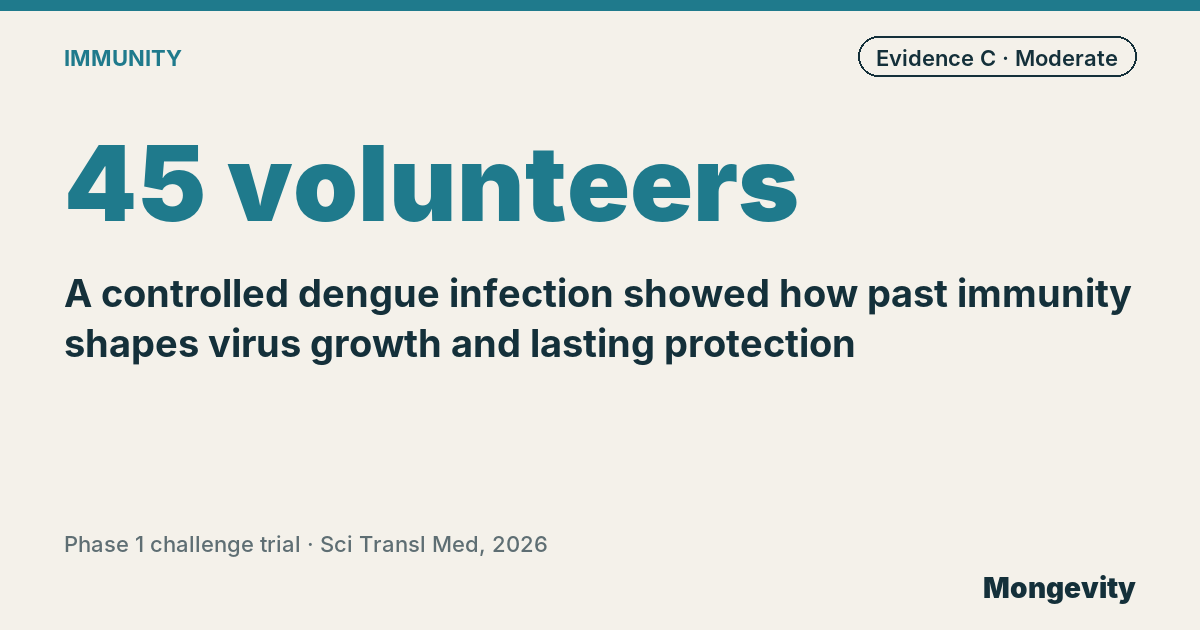
Forty-five healthy adults infected on purpose with a weakened dengue virus showed that existing antibodies and T cells shaped how much the virus grew and how strong and lasting their immune response was, in a phase 1 trial published Oct. 28, 2026, in Science Translational Medicine. It helps explain why repeat infections can differ.
Dengue is unusual: a second infection with a different type of the virus can be worse than the first, because some existing antibodies can help the virus enter cells instead of blocking it. That makes designing vaccines tricky.
What is a controlled human challenge?
It’s a carefully supervised study in which healthy volunteers are deliberately infected, here with a weakened (attenuated) dengue virus, so researchers can watch the immune response from the start, something impossible in natural infections.
What did the study test?
In this phase 1 trial, 45 healthy adults received a weakened dengue virus of a different type from any they’d had before. Researchers compared people having their first, second or third dengue infection, measuring virus levels, symptoms and immune responses.
What did the study find about infections?
- Higher virus levels came with more symptoms, but they stayed mild.
- People having a second infection had more virus, more neutralizing antibodies and stronger protective T cell responses.
- People whose existing antibodies most boosted virus growth in a lab test had delayed immune activation, the highest virus levels and immune responses that faded faster.
- People with more antibodies against a viral protein called NS1, across several types, controlled the virus earlier and developed lasting B and T cell immunity.
- Those who started with potent neutralizing antibodies and certain T cells had minimal virus replication.
Why does this matter?
Understanding which immune responses protect and which backfire helps design dengue vaccines that give broad, long-lasting protection without increasing the risk of severe disease.
How solid is this evidence?
It’s moderate. Mongevity rates it C on our A-to-E scale. Challenge studies give precise, early data, but this one was small, used a weakened virus in healthy adults, and natural infections can behave differently.
What does this mean for you?
If you live in or travel to areas with dengue, avoid mosquito bites with repellent, long sleeves and nets, and remove standing water. Ask a travel or infectious disease doctor whether a dengue vaccine is recommended for you, especially if you’ve had dengue before.
How do I explain this at dinner?
Volunteers agreed to get a weak version of the dengue virus so scientists could watch their bodies fight it from day one. The body’s past experience with dengue changed how the fight went. A good question for the table: why might remembering an old enemy sometimes help and sometimes not?
In one sentence: a controlled dengue infection in volunteers showed that existing immunity shapes how much the virus grows and how lasting protection is, guiding vaccine design.
Questions and answers
- What is a dengue challenge study?
- A supervised study in which healthy volunteers receive a weakened dengue virus so researchers can track infection and immunity from the start.
- Why can a second dengue infection be worse?
- Some existing antibodies can help the virus enter cells; in this study, such antibodies were linked to higher virus levels and faster-fading immunity.
- Does this lead to better vaccines?
- It points to responses, such as antibodies against the NS1 protein, that may give broad, lasting protection.