For menopause symptoms after breast cancer, vaginal laser was no better than a sham
MenopausePart of a story we are following · 11 articles · See every update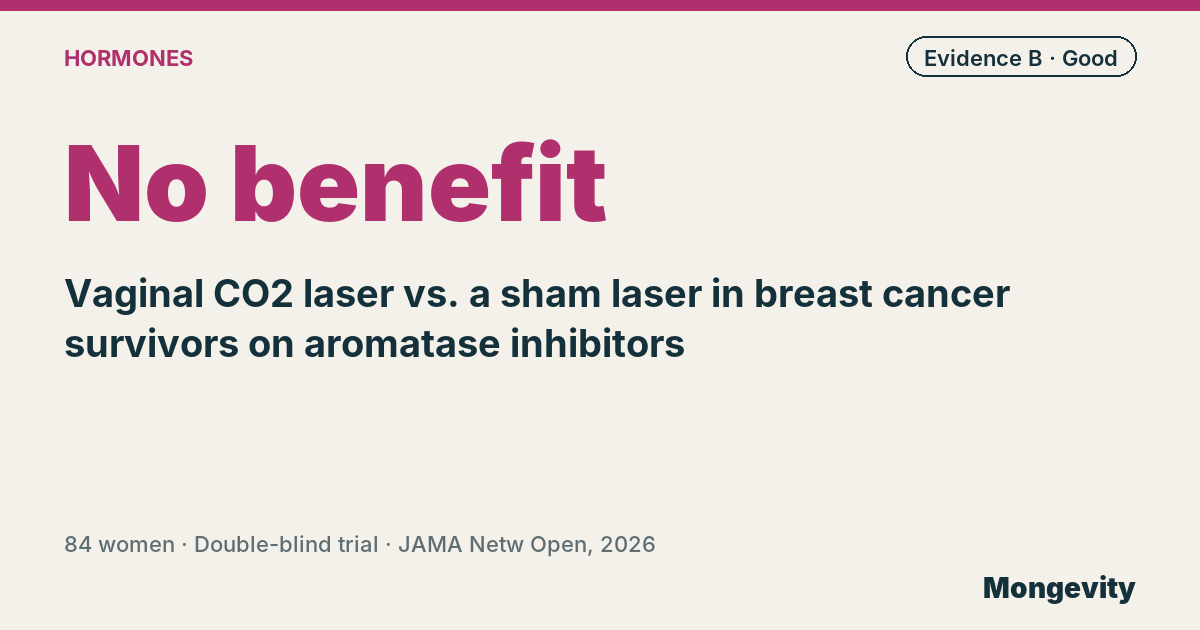
Breast cancer survivors on aromatase inhibitors with vaginal dryness and painful sex improved over 12 months, but CO2 laser therapy added no benefit over a sham laser, in a double-blind trial in Spain published Oct. 1, 2026, in JAMA Network Open. For menopause symptoms after breast cancer, the laser didn’t help.
Many breast cancer survivors take aromatase inhibitors, which lower estrogen and can cause vaginal dryness, irritation and painful sex, known as genitourinary syndrome of menopause. Because hormone creams are often avoided after breast cancer, vaginal laser treatments have become popular. But do they work better than a fake treatment?
What did the trial test?
84 breast cancer survivors in Spain with vaginal symptoms and painful sex, all taking aromatase inhibitors, were assigned by chance to five monthly sessions of fractional CO2 laser or of a sham laser. Both groups also used standard non-hormonal care, including vaginal moisturizers and vibrators. Neither the women nor the evaluators knew who got the real laser. 67 women completed 12 months of follow-up.
What did the study find about menopause?
The laser group didn’t differ from the sham group in sexual function at 12 months, nor in any other outcome. But both groups improved a lot:
| Across all women, baseline to 12 months | Result |
|---|---|
| Sexual function score (FSFI) | from 18.9 to 23.0 |
| Women with more sexual activity | 85.1% |
| Vaginal health index | improved |
No serious side effects occurred.
Why does this matter?
Laser treatments can be expensive and are often paid out of pocket. This trial suggests the improvement many women feel comes from the non-hormonal care, the attention of the trial or other factors, not from the laser itself. It’s a good reminder of why sham-controlled trials matter for procedures, not just for pills.
How solid is this evidence?
It’s good. Mongevity rates it B on our A-to-E scale. The double-blind, sham-controlled design is the right one for this question. Limits: it was a secondary analysis, the trial was small and single-center, and some women didn’t complete follow-up.
What does this mean for you?
If you’re a breast cancer survivor with vaginal dryness or painful sex, talk with your oncology or gynecology team. Regular use of vaginal moisturizers and lubricants, pelvic floor therapy and other non-hormonal options can help. Be cautious about paying for laser treatments, and ask what evidence supports any procedure before you agree to it.
How do I explain this at dinner?
Doctors tested a laser treatment against a fake one, and nobody knew which they got. Both groups felt better, which means the laser itself wasn’t what helped. A good question for the table: why do scientists compare a treatment with a fake one?
In one sentence: for breast cancer survivors with vaginal symptoms, CO2 laser therapy worked no better than a sham, while simple non-hormonal care helped both groups.
Questions and answers
- Does vaginal laser help breast cancer survivors?
- In this trial, CO2 laser added no benefit over a sham laser for sexual or vaginal health at 12 months.
- Why did both groups improve?
- Likely because of non-hormonal care like moisturizers, trial participation or other factors.
- What helps vaginal dryness after breast cancer?
- Non-hormonal moisturizers and lubricants used regularly, pelvic floor therapy and advice from the care team.