Menopause may be less a slow slope than a cliff, 300 million lab tests suggest
MenopausePart of a story we are following · 11 articles · See every update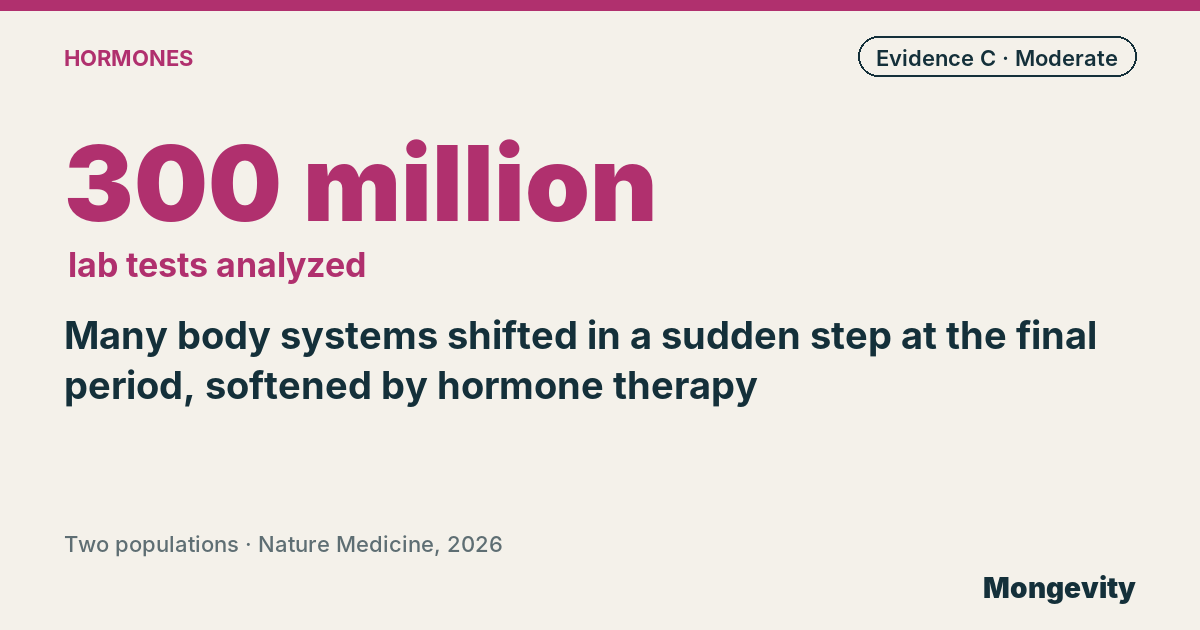
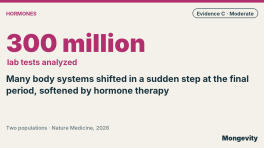
Women’s hormones, bones, liver, kidneys and cholesterol showed a step-like ‘cliff’ at the final menstrual period in a study of 300 million laboratory tests published in October 2026 in Nature Medicine. The change at menopause, absent in men, was softened by menopausal hormone therapy.
Menopause is usually described as a gradual transition.
Why has this been hard to see?
To study changes around menopause, researchers need to know when each woman had her final menstrual period. Large health databases rarely record it, and women reach that point at different ages, which blurs any sharp change when data are averaged.
What did the study do?
The researchers built a computer method, inspired by techniques from astronomy, that removes that blurring. They applied it to two independent groups of people with a total of 300 million laboratory tests, lining up the data around the likely final menstrual period.
What did the study find about menopause?
- At the final period, many measurements shifted in a step, not a slope: hormones, bone, liver, kidney and blood fats.
- These sudden shifts didn’t appear in men, and they were consistent across populations.
- In women using menopausal hormone therapy, the cliff appeared markedly softened.
- Changes began more than a decade before the final period.
Why does this matter?
If menopause brings an abrupt shift in many organs at once, the years around the final period could be a key window for checking bone density, cholesterol, liver and kidney health, and for discussing prevention.
How solid is this evidence?
It’s moderate. Mongevity rates it C on our A-to-E scale. The data set is enormous and the pattern replicated in two groups, but the method reconstructs timing from snapshots rather than following the same women over years. The softening with hormone therapy is an association; it doesn’t prove that therapy prevents harm.
What does this mean for you?
If you’re approaching or going through menopause, it’s a good time for a check-up that includes cholesterol, blood sugar, liver and kidney tests, and a conversation about bone health. Whether hormone therapy makes sense depends on your symptoms and health history; discuss it with your doctor.
How do I explain this at dinner?
Scientists looked at hundreds of millions of blood tests and found that, at a woman’s last period, many things in the body change suddenly, like stepping down a stair instead of walking down a ramp. A good question for the table: why might it help to know a big change is coming?
In one sentence: an analysis of 300 million lab tests suggests that menopause brings a sudden step-change in many body systems at the final period, softened by hormone therapy.
Questions and answers
- Is menopause gradual?
- This study suggests many measurements change in a sudden step at the final menstrual period, though changes begin more than a decade earlier.
- Which body systems change?
- Hormones, bones, liver, kidneys and blood fats showed step-like shifts.
- Does hormone therapy help?
- The cliff appeared markedly softened in women on menopausal hormone therapy, but this is an association, not proof.