After removing a cortisol-making adrenal tumor, the body took months to recover
Cortisol and metabolismPart of a story we are following · 4 articles · See every update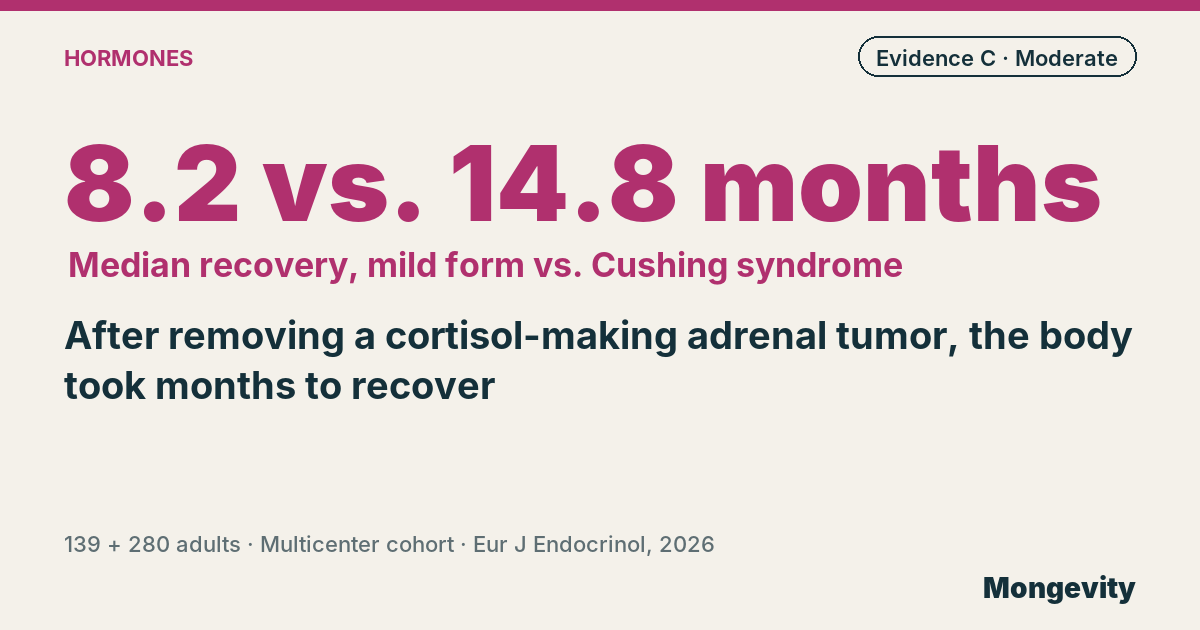
After surgery for an adrenal tumor making too much cortisol, the body’s own cortisol system took a median of 8.2 months to recover in 139 adults with mild cortisol excess and 14.8 months in 280 with Cushing syndrome, in a multicenter study published in August 2026 in European Journal of Endocrinology. Older age delayed recovery.
Some adrenal gland tumors make too much cortisol, the hormone involved in stress, blood sugar and blood pressure. In its full form, this is called Cushing syndrome; a milder form, mild autonomous cortisol secretion, is more common and often found by chance on scans. Removing the tumor fixes the excess, but the rest of the hormone system has been suppressed and needs time to wake up. Meanwhile, patients take replacement steroids.
What did the study look at?
Researchers at several centers reviewed records of 139 adults with mild autonomous cortisol secretion and 280 with adrenal Cushing syndrome who had one adrenal gland removed and needed replacement steroids afterwards. Recovery was defined as being able to stop the replacement.
What did the study find about cortisol?
- The median time to recovery was 8.2 months in mild autonomous cortisol secretion and 14.8 months in Cushing syndrome.
- In both groups, older age was linked to slower recovery.
- In the mild form, a cortisol above 10.0 µg/dL on a standard overnight suppression test added about 113 days to recovery.
- Higher levels of ACTH, the pituitary hormone that stimulates the adrenals, were linked to faster recovery in both groups.
- In Cushing syndrome, higher HbA1c, a marker of long-term blood sugar, was linked to slower recovery.
Why does this matter?
Stopping replacement steroids too early can be dangerous, causing an adrenal crisis; taking them too long has side effects. Knowing typical recovery times and the factors that predict them helps doctors plan follow-up and set realistic expectations for patients.
How solid is this evidence?
It’s moderate. Mongevity rates it C on our A-to-E scale: a multicenter cohort, larger than earlier studies, that separates the two forms of the disease. Limits: it was retrospective, centers may have used different criteria to stop steroids, and it included only patients who needed replacement after surgery.
What are the open questions?
Prospective studies with standard testing schedules could refine predictions and test whether some patients can safely stop sooner.
What does this mean for you?
If you’ve had adrenal surgery for excess cortisol, recovery of your own hormone system can take many months, longer if you’re older or had full Cushing syndrome. Never stop replacement steroids on your own, carry information about your treatment and ask your endocrinologist about a sick-day plan.
How do I explain this at dinner?
Some adrenal tumors pump out too much stress hormone. After they’re removed, the body’s own system is lazy and takes months to restart: about eight months in mild cases and more than a year in severe ones, and longer in older people. A good question for the table: why might the body stop making something it gets from outside?
In one sentence: after unilateral adrenalectomy, recovery of the cortisol axis took a median of 8.2 months in mild autonomous cortisol secretion and 14.8 months in adrenal Cushing syndrome, with older age consistently delaying recovery.
Questions and answers
- What is mild autonomous cortisol secretion?
- A mild excess of cortisol from an adrenal tumor, often found by chance on scans.
- How long does recovery take?
- A median of 8.2 months in the mild form and 14.8 months in Cushing syndrome.
- What slows recovery?
- Older age in both groups, plus specific hormone and blood sugar markers.
- Can I stop replacement steroids on my own?
- No. Stopping too early can cause an adrenal crisis.