Five years on, adding relatlimab to nivolumab still helped people with advanced melanoma
Melanoma treatmentPart of a story we are following · 3 articles · See every update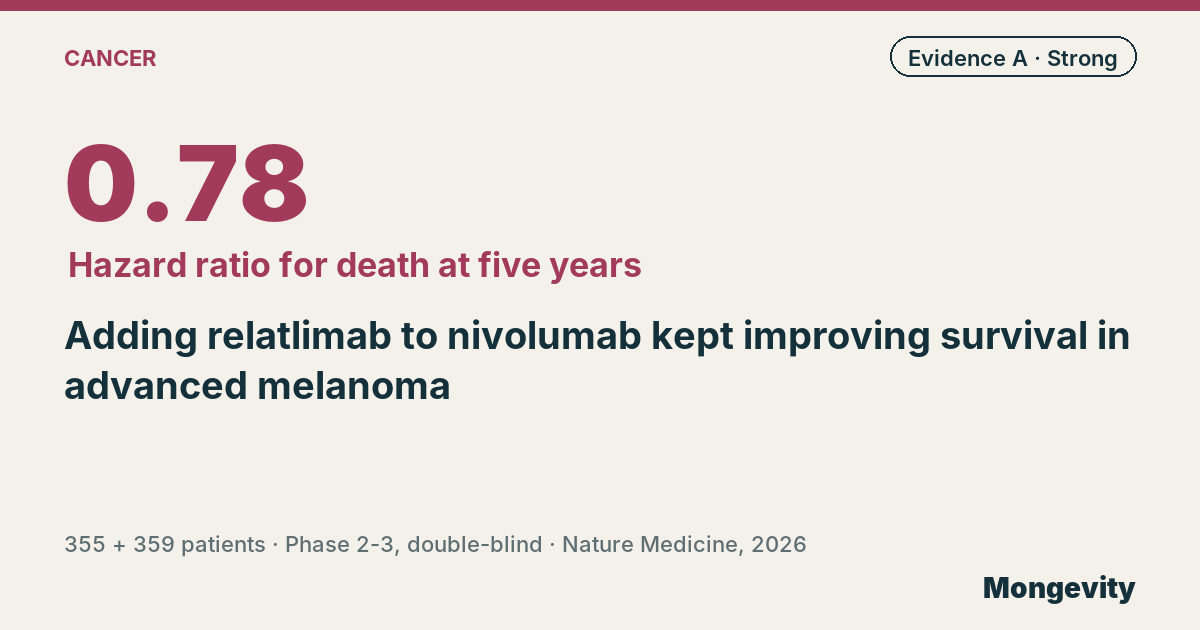
Relatlimab plus nivolumab kept improving survival in advanced melanoma compared with nivolumab alone (hazard ratio for death 0.78), in five-year results of the RELATIVITY-047 trial published Oct. 24, 2026, in Nature Medicine. The combination remains a first option for melanoma.
Immunotherapy transformed treatment for advanced melanoma, a dangerous skin cancer. Nivolumab blocks PD-1, a brake on immune cells. Relatlimab blocks LAG-3, a second brake. The combination was approved based on the RELATIVITY-047 trial, but long-term data were needed.
What did the trial test?
People with metastatic or inoperable melanoma were assigned by chance to nivolumab plus relatlimab (355 patients) or nivolumab alone (359 patients), given by IV every 4 weeks. Neither patients nor doctors knew which they got. The minimum follow-up for this analysis was 57.3 months.
What did the study find about melanoma?
| Nivolumab + relatlimab vs. nivolumab | Hazard ratio |
|---|---|
| Progression-free survival | 0.77 |
| Overall survival | 0.78 |
| Melanoma-specific survival | 0.71 |
The survival curves separated clearly, with the largest absolute differences reported so far. Safety stayed in line with earlier reports. In patients whose tumors had PD-L1 of 1% or more, high levels of LAG-3-positive immune cells were linked to worse results with nivolumab alone, and adding relatlimab was linked to less primary resistance.
Why does this matter?
Long-term data are what count in melanoma, because some people treated with immunotherapy can live for many years. Early results can look promising and then fade, so a benefit that still shows after this much follow-up is reassuring for patients and doctors weighing the combination. It also matters that the drugs are given together in a single IV infusion schedule. Five-year results confirm that the two-brake approach gives a lasting benefit and suggest it may help overcome a specific form of resistance.
How solid is this evidence?
It’s strong. Mongevity rates it A on our A-to-E scale: a large double-blind randomized trial with long follow-up and benefit in overall survival. Limits: some analyses, such as melanoma-specific survival and the biomarker findings, were post hoc or exploratory.
What does this mean for you?
If you or someone close to you has advanced melanoma, ask the oncologist which immunotherapy combinations are options, including nivolumab plus relatlimab, and how they compare in benefits and side effects. Protect your skin from the sun and check moles regularly.
How do I explain this at dinner?
The immune system has brakes that cancer can press to hide. One medicine releases one brake; a second releases another. Five years later, people with melanoma who got both still did better. A good question for the table: why might releasing two brakes help more than one?
In one sentence: five-year results confirmed that adding relatlimab to nivolumab gives a lasting survival benefit in advanced melanoma.
Questions and answers
- What is relatlimab?
- An immunotherapy that blocks LAG-3, an immune brake, and is given together with nivolumab, which blocks PD-1.
- Does the benefit last?
- Yes: at five years, the hazard ratio for death was 0.78 vs. nivolumab alone.
- Who benefits most?
- Exploratory analyses suggest the combination may help overcome LAG-3-related resistance, but this needs confirmation.