A team-guided immunotherapy plan got most borderline lung cancer patients to curative care
Lung cancerPart of a story we are following · 9 articles · See every update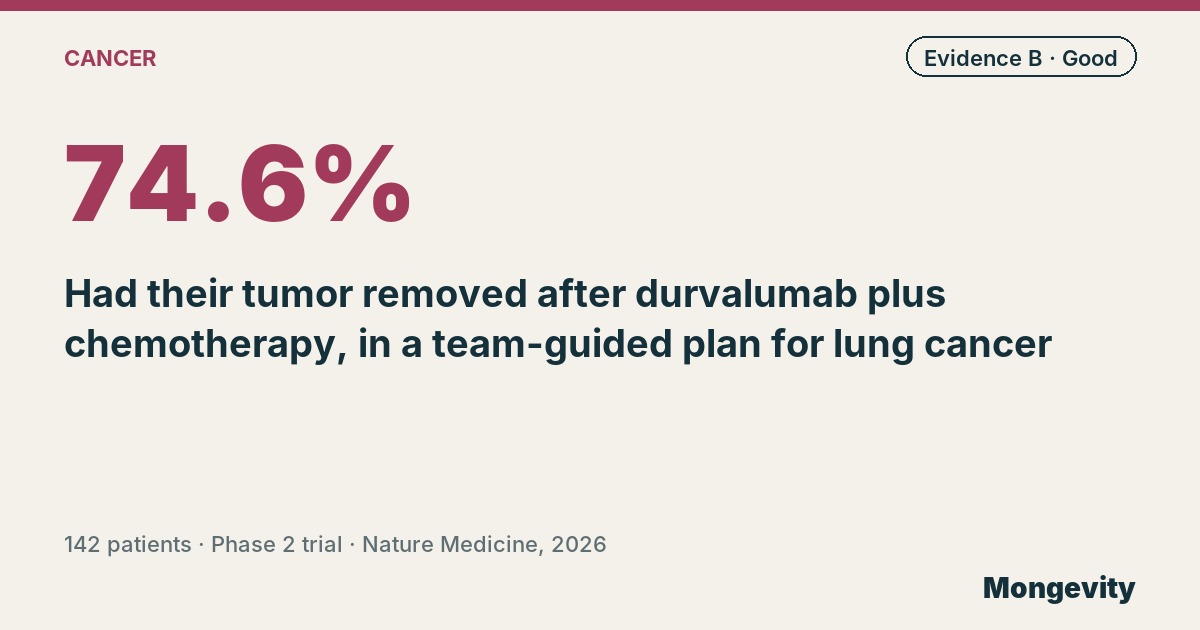
Of 142 people with resectable or borderline lung cancer who got durvalumab plus chemotherapy before surgery, 74.6% had their tumor removed and 92.3% received surgery or curative radiation, in the phase 2 MDT-BRIDGE trial published Oct. 26, 2026, in Nature Medicine. A team-based plan helped more lung cancer patients reach curative care.
For lung cancer that can be operated on, giving immunotherapy plus chemotherapy before and after surgery has become a standard. But some tumors are borderline: it’s not clear at first whether surgery will be possible.
What did the trial test?
142 people with non-small cell lung cancer, 64.8% judged resectable and 35.2% borderline at the start, received durvalumab, an immunotherapy, plus chemotherapy before surgery. A team of surgeons, oncologists and radiation specialists then decided: those who could be operated on had surgery followed by more durvalumab; those who couldn’t got chemoradiotherapy followed by durvalumab.
What did the study find about lung cancer?
| Outcome | Result |
|---|---|
| Tumor removed with surgery | 74.6% |
| Complete removal with clear margins, among those operated | 96.2% |
| Surgery or curative chemoradiotherapy | 92.3% |
| Went on to receive durvalumab afterward | 82.4% |
During the durvalumab phase after treatment, serious side effects occurred in 7.4% of operated patients and 17.4% of those who had chemoradiotherapy.
Why does this matter?
People with borderline tumors are often left out of trials. This study shows that a team-guided plan can bring most of them to a treatment aimed at cure, either surgery or radiation, without abandoning the benefits of immunotherapy. It also shows the value of deciding the next step after seeing how the tumor responds, instead of fixing the whole plan at the start.
How solid is this evidence?
It’s good, but early. Mongevity rates it B on our A-to-E scale. It was a phase 2 study without a comparison group, and its main result was descriptive. Survival outcomes are still to come.
What does this mean for you?
If you or someone close to you has lung cancer that might be operable, ask whether the case will be reviewed by a multidisciplinary tumor board, and whether immunotherapy before surgery is an option. A second opinion at a high-volume center can help with borderline cases. Ask, too, how side effects of immunotherapy will be monitored, since they can appear weeks or months after starting.
How do I explain this at dinner?
Some lung tumors are on the edge of being removable. Doctors gave medicines first and then met as a team to decide the best next step for each person, and most ended up with a treatment aimed at cure. A good question for the table: why do teams sometimes decide better than one person?
In one sentence: a team-guided plan with immunotherapy before surgery brought most people with resectable or borderline lung cancer to curative-intent treatment.
Questions and answers
- What is a borderline resectable lung cancer?
- A tumor where it's not clear at first whether surgery will be possible.
- How many people got surgery?
- 74.6% had their tumor removed, and 92.3% received surgery or curative chemoradiotherapy.
- Is this a new standard?
- Not yet: it's a phase 2 result without a comparison group, and survival data are pending.