Adding immunotherapy to radiation didn’t help early lung cancer, and the trial stopped
Lung cancerPart of a story we are following · 9 articles · See every update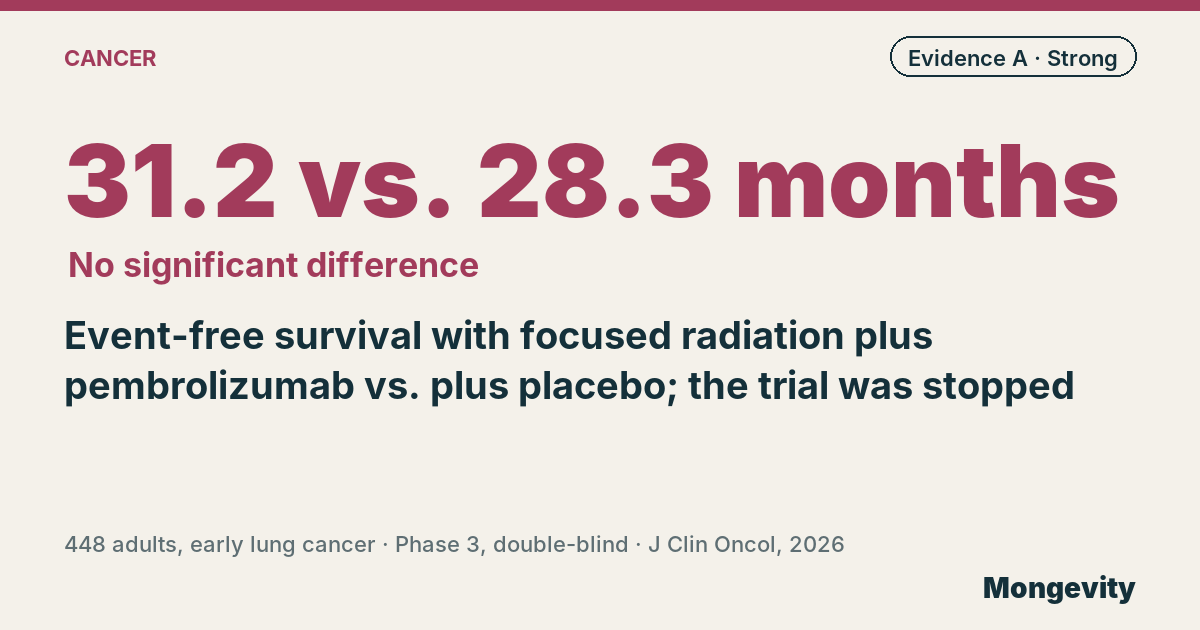
Adding pembrolizumab to focused radiation for early lung cancer that wasn’t operated on did not delay recurrence and caused more serious side effects, 20.4% vs. 3.7%, in a phase 3 trial published Oct. 28, 2026, in Journal of Clinical Oncology. The lung cancer trial was stopped early.
Not every new combination works, and negative results matter too. When early lung cancer can’t be removed with surgery, or the person prefers not to have an operation, the standard treatment is stereotactic body radiotherapy (SBRT): a few high, precise doses of radiation aimed at the tumor.
It didn’t, and it caused more harm.
What did the trial test?
448 adults with untreated stage I or II non-small cell lung cancer that was inoperable, or who declined surgery, received SBRT plus either pembrolizumab or a placebo every three weeks, for up to 17 doses. Neither patients nor doctors knew which one they got.
What did the study find about lung cancer?
| SBRT + pembrolizumab | SBRT + placebo | |
|---|---|---|
| Median event-free survival | 31.2 months | 28.3 months |
| Serious treatment side effects | 20.4% | 3.7% |
| Deaths related to treatment | 5 (2.2%) | 0 |
The difference in event-free survival was small and not statistically significant (hazard ratio 0.92). Because the risks outweighed the benefits, the trial was stopped early and all study treatment was halted.
Why does this matter?
Immunotherapy has changed the outlook for many people with advanced lung cancer, so it was reasonable to hope it would also help earlier, smaller tumors treated with radiation. This trial shows the idea doesn’t carry over automatically. In early disease, many people do well with radiation alone, so any extra treatment has to clear a high bar: it must add enough benefit to justify its risks. Here it didn’t. Negative trials like this one protect patients from treatments that sound promising but add harm, and they help researchers decide where to look next.
How solid is this evidence?
It’s strong: a randomized, double-blind phase 3 trial with outcomes judged by independent reviewers. Mongevity rates it A. It’s an interim analysis, but the trial was closed because of the benefit-risk balance, so no later answer is expected.
What does this mean for you?
For early lung cancer treated with SBRT, radiation alone remains the standard; adding pembrolizumab brought more side effects without a clear benefit. If you or a family member is offered SBRT for early lung cancer, it’s reasonable to ask the team what the plan is for follow-up scans.
How do I explain this at dinner?
Scientists tried adding a second medicine to a treatment that already works well. It didn’t help and it caused more problems, so they stopped. A good question for the table: when is adding more of something not better?
In one sentence: in early lung cancer treated with precise radiation, adding immunotherapy didn’t prevent the cancer from returning and caused more serious side effects.
Questions and answers
- What is SBRT?
- Stereotactic body radiotherapy: a few high, precise doses of radiation aimed at a small tumor. It's the standard for early lung cancer that isn't operated on.
- Does pembrolizumab help after SBRT in early lung cancer?
- No. In KEYNOTE-867 it didn't improve event-free survival (31.2 vs. 28.3 months, not significant) and caused more serious side effects.
- Why was the trial stopped?
- Because the benefit-risk profile was unfavorable: serious side effects were 20.4% vs. 3.7%, and there were five treatment-related deaths in the pembrolizumab group.