Lung cancer resistant to EGFR pills was slowed longer by a two-target drug than by chemo
Lung cancerPart of a story we are following · 9 articles · See every update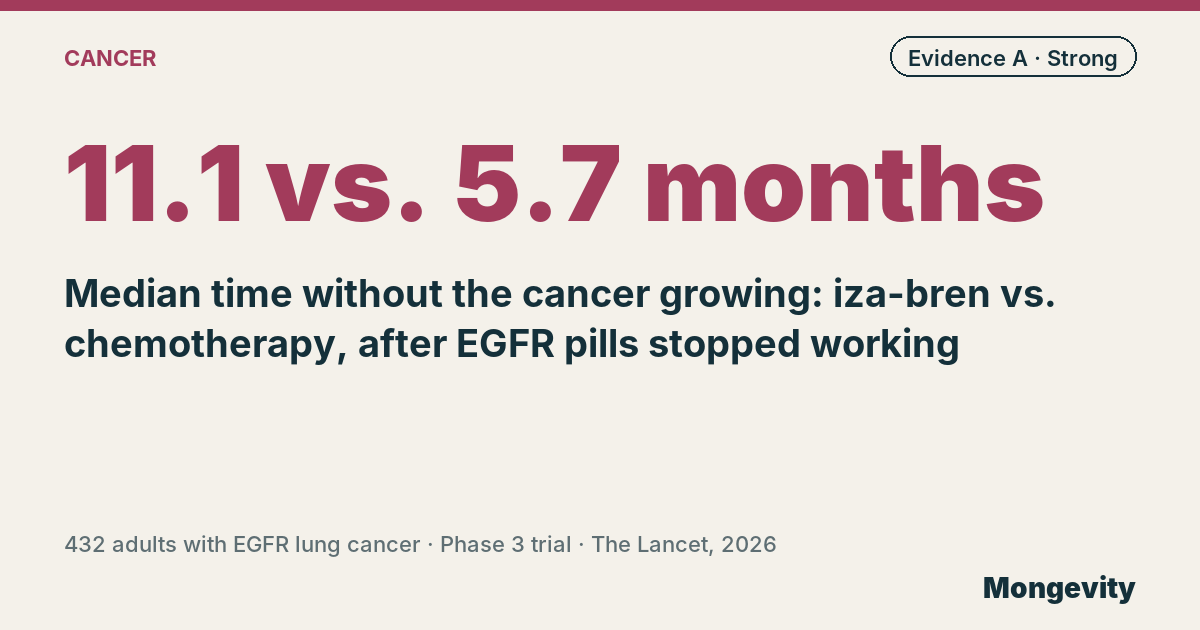
People with EGFR lung cancer that had grown on third-generation EGFR pills went a median 11.1 months without progression on iza-bren, vs. 5.7 months on chemotherapy, in a phase 3 trial in China published Oct. 26, 2026, in The Lancet. Serious side effects were more common with the new lung cancer drug.
Many lung cancers driven by a change in the EGFR gene are first treated with pills such as osimertinib. When those pills stop working, the usual next step is chemotherapy.
People on iza-bren went a median of 11.1 months before their cancer grew, compared with 5.7 months on chemotherapy. The trade-off: serious side effects were more frequent.
What is iza-bren?
It’s an antibody-drug conjugate, a drug that works like a guided missile. An antibody finds the cancer cell and delivers a dose of chemotherapy straight to it. Iza-bren is the first of its kind to aim at two targets at once, EGFR and HER3, both common on these tumors.
What did the trial test?
At 73 hospitals in China, 432 people with advanced EGFR lung cancer that had grown on a third-generation EGFR pill were assigned by chance to iza-bren (an IV infusion on days 1 and 8 of each three-week cycle) or standard platinum chemotherapy. Independent reviewers who didn’t know the treatment judged whether the cancer grew.
What did the study find about lung cancer?
| Iza-bren | Chemotherapy | |
|---|---|---|
| Median time without the cancer growing | 11.1 months | 5.7 months |
| Serious (grade 3+) treatment side effects | 79% | 62% |
| Lung inflammation from treatment | 1% | 0% |
The hazard ratio for progression was 0.40. A hazard ratio below 1 means the cancer grew more slowly with iza-bren than with chemotherapy. Most serious side effects were drops in blood counts. Overall survival was still an interim analysis, so it’s not yet known whether people live longer.
Why does this matter?
When EGFR pills stop working, options have been limited, and chemotherapy has been the default for years. Antibody-drug conjugates are one of the busiest areas of cancer research because they try to hit the tumor hard while sparing more of the healthy tissue. This is the first phase 3 trial of one that targets two proteins at once, so other drugs of this kind will be measured against it. It also shows a pattern that repeats across cancer care: a longer time without progression doesn’t automatically mean a gentler treatment, and patients and doctors have to weigh both.
How solid is this evidence?
It’s strong for what it measured. The trial was large, randomized and phase 3, and the main result was checked by blinded reviewers. Mongevity rates it A on our A-to-E scale. Limits: it was open-label, all patients were in China, it was funded by the company that makes the drug, and survival data aren’t final.
What does this mean for you?
If you or someone in your family has EGFR lung cancer that grew on osimertinib or a similar pill, iza-bren is a name to bring up with the oncologist, along with whether clinical trials or approvals exist where you live. Decisions belong with the cancer team.
How do I explain this at dinner?
Some medicines work like a guided missile: they find the sick cells and drop the medicine right there. This new one looks for two flags on the cancer cell instead of one. A good question for the table: why is it useful to have more than one way to find a target?
In one sentence: a guided-missile drug with two targets kept EGFR lung cancer in check longer than chemotherapy, at the cost of more serious side effects.
Questions and answers
- What is iza-bren?
- Izalontamab brengitecan is an antibody-drug conjugate that targets EGFR and HER3 at once and delivers chemotherapy directly to cancer cells.
- Does iza-bren help people live longer?
- It's not known yet. The trial showed a longer time without the cancer growing (11.1 vs. 5.7 months); survival data are still interim.
- Is it gentler than chemotherapy?
- No. Serious side effects were more common with iza-bren (79% vs. 62%), mostly drops in blood counts.