Counselors’ stereotypes worsened cancer genetic counseling for Black patients
Cancer and inequalityPart of a story we are following · 3 articles · See every update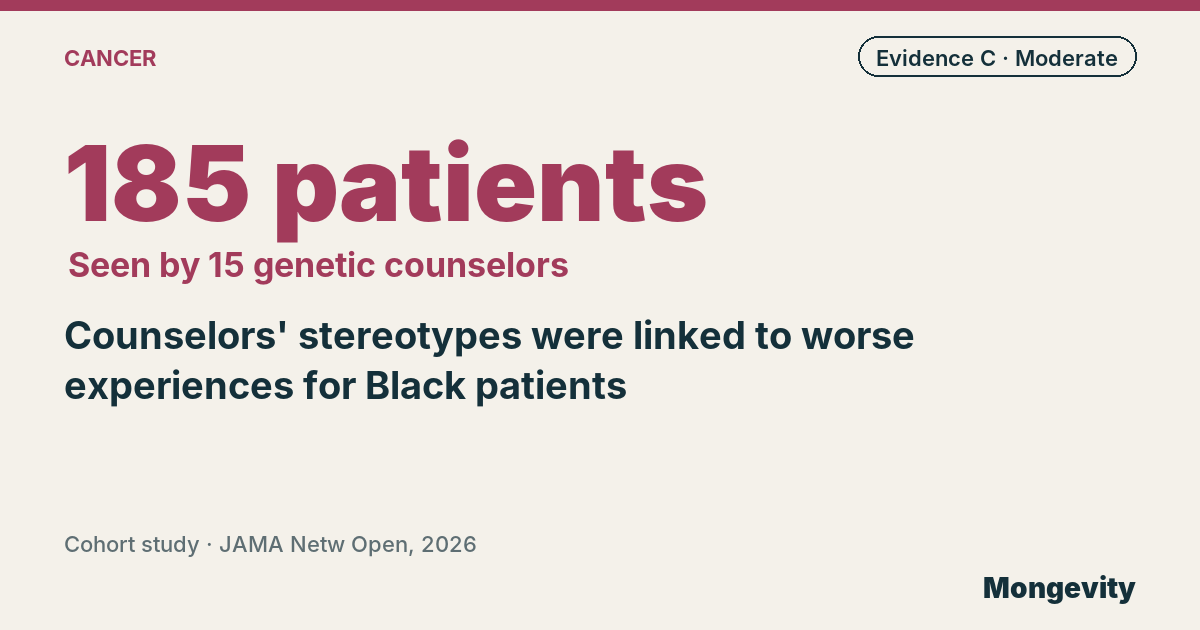
Genetic counselors’ explicit stereotypes favoring White patients were linked to poorer alliance, satisfaction and decision-making among Black patients, in a US study of 185 patients and 15 counselors published Oct. 1, 2026, in JAMA Network Open. It is a concrete example of cancer and inequality in care.
Genetic counseling helps people understand their inherited cancer risk, such as BRCA variants, and decide on testing, screening or prevention. But not everyone has the same experience.
What did the study do?
At 2 comprehensive cancer centers in the US South and Midwest, from 2023 to 2025, researchers studied 185 patients, 83 Black and 102 White, who saw 1 of 15 genetic counselors for hereditary cancer risk assessment. Before the sessions, counselors completed tests and questionnaires measuring implicit and explicit prejudice and stereotypes. Sessions were recorded, and patients rated the working relationship, satisfaction and how conflicted they felt about decisions.
What did the study find about cancer and inequality?
Among Black patients, counselors’ stronger endorsement of explicit medical stereotypes favoring White over Black patients was linked to:
- A poorer working relationship with the counselor.
- Lower satisfaction.
- Greater conflict about decisions.
Among White patients, no biases were significantly linked to outcomes. Explicit medical-context stereotyping was the only factor consistently linked to racial differences in patient experience.
Why does this matter?
Black patients are already less likely to receive genetic counseling and testing. If those who do receive it have worse experiences because of clinicians’ stereotypes, gaps in cancer prevention can widen. The finding points to a specific, addressable target: explicit beliefs in medical settings.
How solid is this evidence?
It’s moderate. Mongevity rates it C on our A-to-E scale: a careful study with recorded sessions and validated measures, but small, with 15 counselors at 2 centers, mostly female patients and an observational design that can’t prove cause.
What are the open questions?
Researchers need to test whether training or feedback that addresses stereotypes improves patient experiences and closes gaps in testing and prevention.
What does this mean for you?
If you’re considering genetic counseling, you have the right to understand your options and feel heard. Bring your questions, and if something isn’t clear or a session feels off, ask for more explanation or another appointment.
How do I explain this at dinner?
Genetic counselors help people understand their family cancer risk. When counselors held stronger stereotypes about Black patients, those patients felt less connected, less satisfied and more unsure about their decisions. A good question for the table: what makes you trust a health professional?
In one sentence: counselors’ explicit medical stereotypes were linked to poorer genetic counseling experiences for Black patients, a target for efforts to reduce cancer care disparities.
Questions and answers
- What is cancer genetic counseling?
- A session to understand inherited cancer risk and decide about testing, screening or prevention.
- What did counselor stereotypes affect?
- Black patients' sense of alliance, satisfaction and decision conflict.
- Were implicit biases linked to outcomes?
- Only explicit medical-context stereotyping was consistently linked.