Not just T cells: B cells may help some cancers stay away after immunotherapy
How immunotherapy worksPart of a story we are following · 2 articles · See every update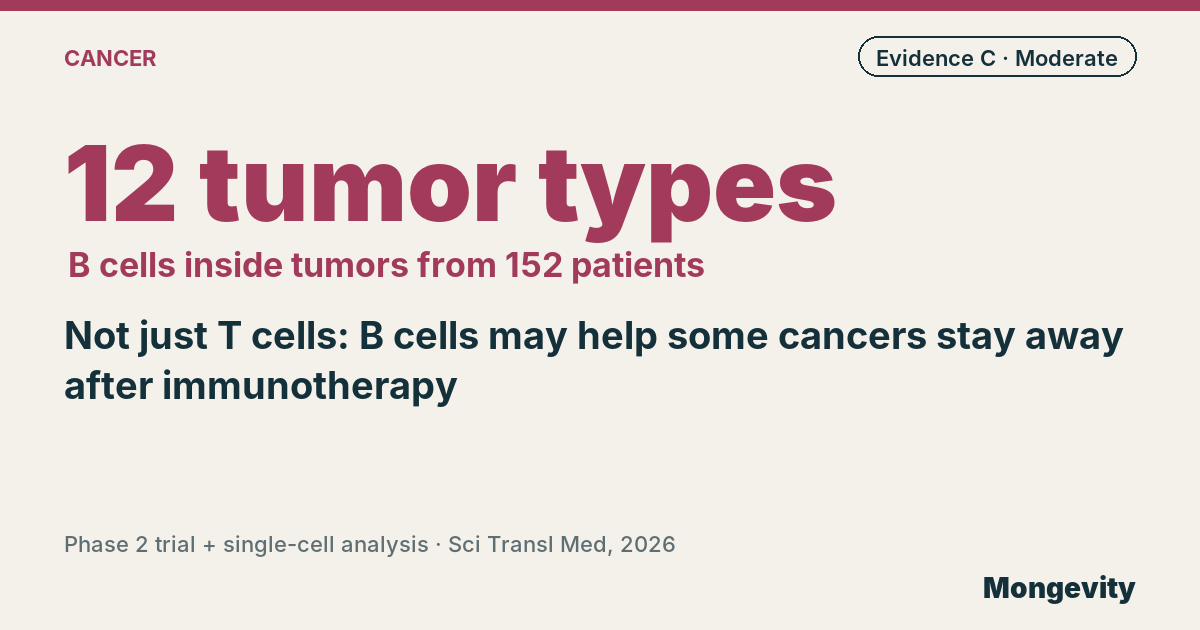
B cells and antibody responses were linked to complete, lasting responses to immunotherapy in some cancer types, in a study combining a phase 2 trial of 106 patients with tumor data from 152 patients, published Oct. 28, 2026, in Science Translational Medicine. The finding broadens how scientists think immunotherapy works.
Immune checkpoint inhibitors, drugs that release the brakes on the immune system, have changed cancer treatment. Most research has focused on T cells, the immune cells that attack tumors directly. B cells, which make antibodies, have received much less attention.
What did the study do?
It combined several pieces of work:
- A prospective randomized phase 2 trial of 106 patients treated with immune checkpoint inhibitors, in which researchers looked at B cell antibody responses.
- A large single-cell RNA database of B cells inside tumors, covering 12 tumor types from 152 patients.
- Patients who received rituximab, a drug that depletes B cells, before surgery, to see what happened to T cells inside the tumor.
What did the study find about immunotherapy?
- B cell antibody responses were linked to exceptional complete responses to immunotherapy in certain cancer types.
- The role of B cells depended on the context: they seemed helpful in some cancer types and possibly unfavorable in others.
- Germinal center and memory B cells were more common in groups with a better outlook; plasma cells making immunoglobulin A were more common in groups with a worse one.
- Removing B cells with rituximab changed the number and diversity of T cells in tumors.
- B cells were linked to better long-term survival even when T cells were already abundant in the tumor.
Why does this matter?
It suggests that the strongest, longest-lasting tumor control after immunotherapy comes from both arms of the adaptive immune system working together, T cells and B cells. In the future, measuring B cells could help predict who benefits, and new treatments could try to boost them.
How solid is this evidence?
It’s moderate for patients today. Mongevity rates it C on our A-to-E scale: it includes a randomized phase 2 trial, but the B cell findings are associations and lab analyses, mixed across many cancer types. They point to mechanisms rather than to a new treatment.
What does this mean for you?
Nothing changes in treatment yet. If you or someone close to you is receiving immunotherapy, ask the oncologist whether clinical trials studying biomarkers or new combinations are available. Keep vaccines up to date as advised by your care team.
How do I explain this at dinner?
Cancer immunotherapy is usually explained as unleashing the immune system’s soldiers, the T cells. This study suggests another team, the B cells that make antibodies, also helps some people stay cancer-free for a long time. A good question for the table: why might two teams beat one?
In one sentence: B cells and antibody responses were linked to complete, lasting responses to immunotherapy in some cancers, suggesting T cells and B cells work best together.
Questions and answers
- What are B cells?
- Immune cells that make antibodies and help coordinate the immune response.
- How do they relate to immunotherapy?
- In this study, B cell antibody responses were linked to complete, lasting responses in some cancer types.
- Does this change treatment now?
- Not yet: it points to mechanisms that need to be tested in new trials.