Calming emotions, key to mental health, can’t be read from one brain area
Stress and the mindPart of a story we are following · 4 articles · See every update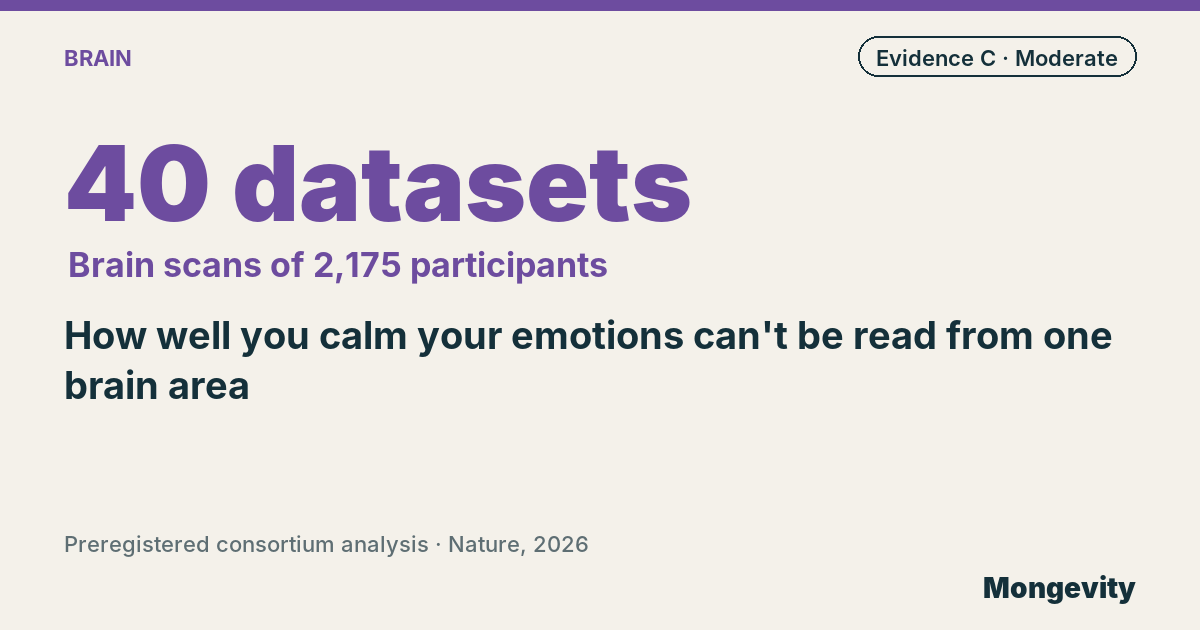
Common measures of how well people reframe emotions didn’t agree with each other or with the expected brain circuits in 40 brain-imaging datasets with 2,175 participants, in a preregistered analysis published Oct. 28, 2026, in Nature. For stress and mental health, there is no single brain marker of emotional control yet.
Cognitive reappraisal means changing how you think about a situation to change how it makes you feel, for example, seeing a canceled plan as a free evening rather than a letdown. It’s a core skill in well-being and in therapies such as cognitive behavioral therapy. Scientists have long assumed that activity in the prefrontal cortex, the brain’s “control” region, shows how good a person is at it.
What did the study do?
A consortium analyzed 40 brain imaging datasets, using functional MRI during emotion tasks, with 2,175 participants. The plan was preregistered, meaning the analysis was set in advance. They compared three common ways to measure reappraisal capacity:
- Questionnaires in which people rate their usual habits.
- People’s own ratings of how they felt during the task.
- How much the amygdala, a region linked to emotional reactions, calmed down when they reappraised.
What did the study find about stress and mental health?
- The three measures didn’t agree with each other.
- None showed the expected link with the prefrontal control circuits.
- Questionnaires showed no detectable link with brain activity anywhere.
- Task ratings were linked instead to the amygdala and to sensory and motor areas.
- The control circuits were active both when emotions were generated and when they were regulated, so they aren’t specific to regulation.
Why does this matter?
It’s common to hear that someone “can’t regulate emotions” because a brain region is weak. This study suggests that’s an oversimplification: you can’t infer how well a person manages emotions from activity in one supposed regulation center. That matters for brain-based tests, for treatments that target specific regions and for how emotions are explained to the public.
How solid is this evidence?
It’s moderate for practical use. Mongevity rates it C on our A-to-E scale: a large, preregistered analysis across many datasets, which makes it robust for what it tested, but it’s about how we measure the brain, not about a treatment, and the tasks were done in a scanner, not in daily life.
What does this mean for you?
Reappraisal is still a useful skill: practicing it, alone or with a therapist, can help. Just be wary of products or claims that promise to measure or fix your emotional control by targeting one brain area. How you feel and cope in daily life is the measure that counts.
How do I explain this at dinner?
Scientists thought they could see how good someone is at calming down by looking at one part of the brain. A huge study of brain scans found that doesn’t work: the brain is messier than that. A good question for the table: how do you know when you’ve calmed yourself down?
In one sentence: a large brain imaging study found no single brain signature of emotion regulation capacity, cautioning against reading it from one region.
Questions and answers
- What is cognitive reappraisal?
- Changing how you think about a situation to change how it makes you feel.
- What did the study find?
- Three common measures of reappraisal capacity didn't agree with each other or with the expected prefrontal circuits.
- Is reappraisal still useful?
- Yes: the study is about how it's measured in the brain, not about whether the skill helps.