In a small trial, stem-like cell infusions eased arthritis signs in cats
Arthritis in dogs and catsPart of a story we are following · 3 articles · See every update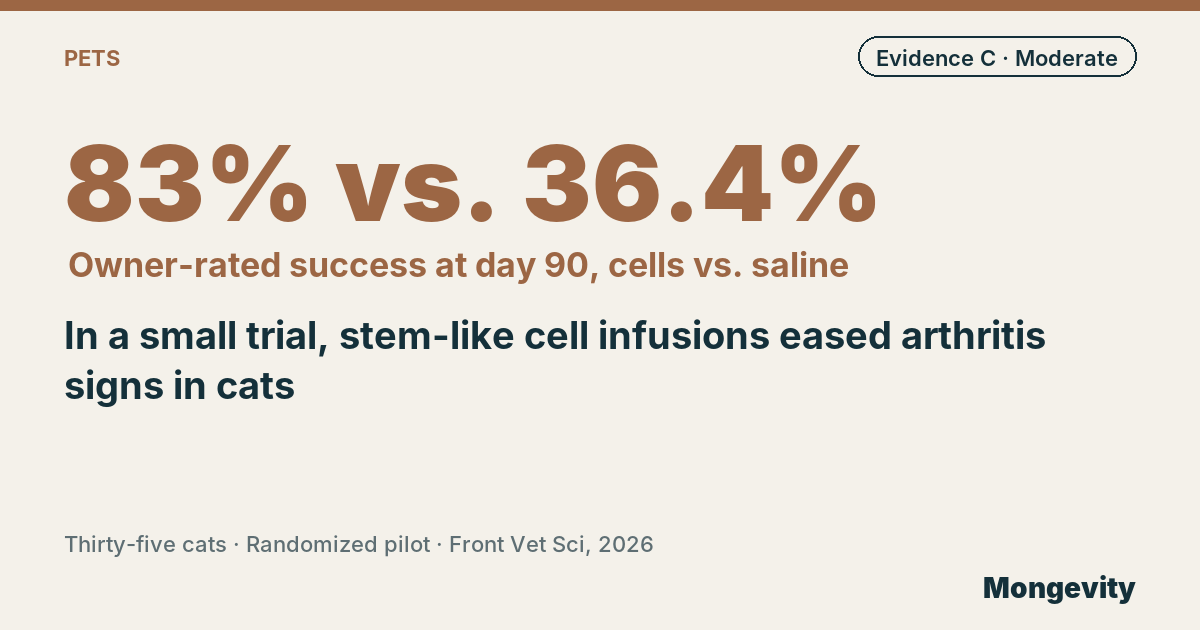
Two infusions of donor stromal cells led to owner-rated treatment success in 78% to 83% of cats with osteoarthritis at 90 days, vs. 36.4% with saline, in a randomized pilot of thirty-five cats at six veterinary clinics, published Sept. 4, 2026, in Frontiers in Veterinary Science. Cell therapy for arthritis in pets is still experimental.
Osteoarthritis is common in older cats, but often missed because cats hide pain: they jump less, groom less or avoid stairs. Treatment options are limited. Mesenchymal stromal cells, sometimes called stem-like cells, can calm inflammation.
What did the trial test?
Thirty-five pet cats with naturally occurring osteoarthritis at six veterinary clinics were assigned by chance to two intravenous injections, 14 days apart, of 5 million donor stromal cells, 20 million cells, or saline placebo. Owners and veterinarians didn’t know which treatment each cat received. They rated the cats with owner questionnaires on specific activities, overall assessments and pain scores up to day 90.
What did the study find about arthritis in pets?
- On owner-rated activity and overall assessment, treatment success at day 90 was 78% (7 of 9) with 5 million cells and 83% (10 of 12) with 20 million cells, vs. 36.4% (4 of 11) with placebo.
- Veterinarians’ pain assessment showed success in 75% and 83% of treated cats, vs. 45% with placebo.
- Side effects related to treatment occurred in 10% with 5 million cells, 38% with 20 million cells and 16.7% with saline.
- The most common were transient vomiting or nausea, weakness, lethargy, drooling and fast breathing within the first 24 hours.
Why does this matter?
Few treatments for arthritis are approved for long-term use in cats. If these results hold up, cell therapy could become an option for cats who don’t respond to, or can’t take, other treatments.
How solid is this evidence?
It’s early. Mongevity rates it C on our A-to-E scale: a randomized, masked, placebo-controlled trial, but a pilot with very small groups, not all cats were assessed for every outcome, and follow-up lasted 3 months. The placebo group also improved, which is common in pet arthritis studies.
What are the open questions?
Larger trials are needed to confirm the benefit, choose the best dose, check long-term safety and see how long the effect lasts.
What does this mean for you?
If your older cat jumps less, misses the litter box or seems grumpy when touched, ask your veterinarian about arthritis. Low ramps, softer beds and litter boxes with low sides help right away, and there are medicines to discuss. Cell therapy is still experimental.
How do I explain this at dinner?
Cats with arthritis got two drips of donor cells that calm inflammation, or salt water. Three months later, most owners of treated cats saw them moving and acting better, compared with about a third of the placebo group. A good question for the table: how would you know if a cat is in pain?
In one sentence: in a randomized pilot, intravenous donor uterine-derived stromal cells were well tolerated and improved owner and veterinarian assessments in cats with osteoarthritis at 3 months.
Questions and answers
- What are stromal cells?
- Cells that can calm inflammation and support tissue repair; here, from donor cats' uterine tissue.
- Did they help?
- Owner-rated success at day 90 was 78% to 83% vs. 36.4% with saline.
- Were there side effects?
- Mostly mild and transient, more frequent at the higher dose (38%).
- Can my cat get this?
- It's still experimental; ask your veterinarian about current options.