‘Forever chemicals’ were in almost all cats and dogs, but not linked to hormone disease
Senior catsPart of a story we are following · 3 articles · See every update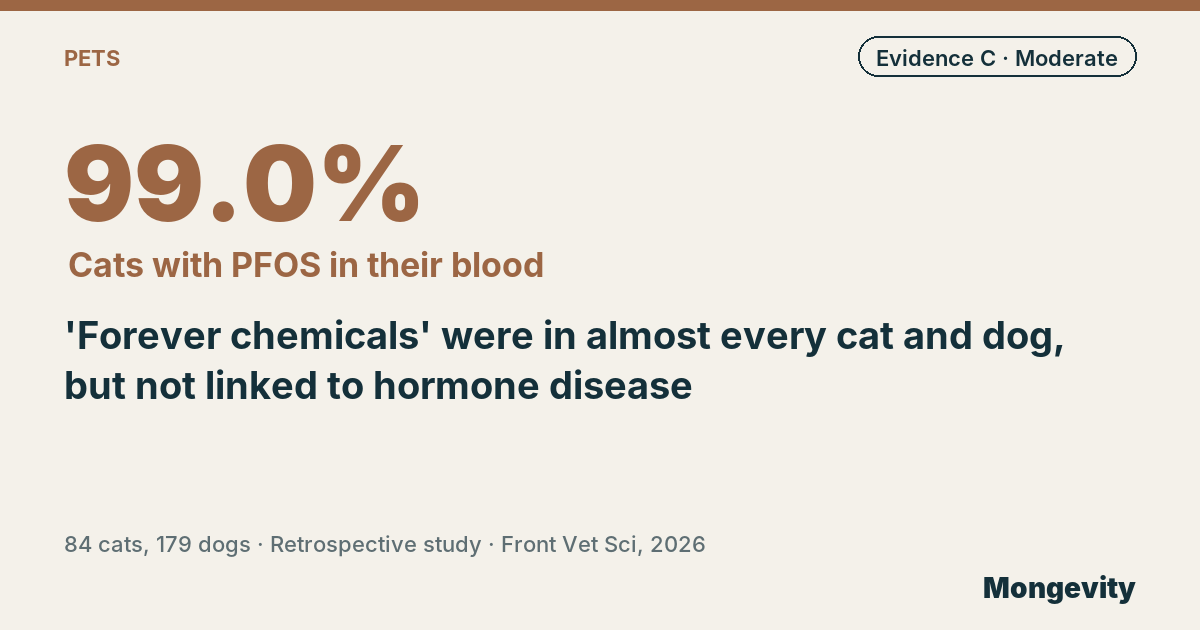
PFAS ‘forever chemicals’ were found in nearly every one of 84 cats and 179 dogs in Italy and the Netherlands, with PFOS in 99.0% of cats, in a study published Aug. 24, 2026, in Frontiers in Veterinary Science. After accounting for age, no PFAS was linked to hormone diseases common in senior cats, such as hyperthyroidism.
PFAS, often called “forever chemicals”, are industrial compounds used in non-stick pans, stain-proof fabrics and food packaging. They persist in the environment and the body and can disrupt hormones. Hyperthyroidism, an overactive thyroid, is one of the most common diseases of older cats, and some have suspected household chemicals.
What did the study look at?
Researchers analyzed blood samples from 179 dogs at universities in Bologna and Utrecht, and 84 cats from Bologna, collected between 2021 and 2025. The cats included 35 healthy animals and 49 with hyperthyroidism; the dogs included healthy animals and dogs with several hormone disorders. They measured eleven PFAS with a precise laboratory method and compared groups, adjusting for age.
What did the study find about senior cats?
- PFAS exposure was widespread: PFOS was found in 99.0% of cats and PFOA in 96.0%.
- In dogs, PFOS was found in 99.5%, and dogs from Utrecht had higher levels than dogs from Bologna.
- Before adjusting, some differences appeared between healthy and sick animals, but in opposite directions in cats and dogs.
- After adjusting for age, no PFAS was linked to any hormone disease in either species.
- PFAS levels were slightly lower in older animals, and sick animals were older, which explains much of the apparent differences.
Why does this matter?
Pets share our homes and are exposed to the same chemicals. This study shows that almost all of them carry PFAS. The good news is that, in this study, PFAS weren’t linked to feline hyperthyroidism or canine hormone diseases once age was considered.
How solid is this evidence?
It’s limited. Mongevity rates it C on our A-to-E scale: a careful laboratory study with age adjustment, but retrospective and with relatively small groups. Limits: it measured PFAS at one point in time, so it can’t capture past exposure when disease began, and almost every animal was exposed, so there was no truly unexposed comparison group.
What are the open questions?
Long-term studies that follow pets over time, including animals with minimal exposure, are needed to understand the health effects of PFAS in cats and dogs.
What does this mean for you?
If you have an older cat, ask your veterinarian about blood tests for thyroid and kidney function, which help catch common diseases early. To reduce PFAS exposure for everyone at home, avoid scratched non-stick pans, choose fresh foods over greasy packaged ones and keep dust down.
How do I explain this at dinner?
Researchers tested cats and dogs for “forever chemicals” from non-stick pans and packaging. Almost all of them had some. But once age was considered, those chemicals weren’t linked to thyroid or other hormone diseases. A good question for the table: what in our kitchen might shed these chemicals?
In one sentence: PFAS exposure was nearly universal in dogs and cats, but no PFAS was independently associated with endocrine disease after adjusting for age.
Questions and answers
- What are PFAS?
- Persistent industrial chemicals used in non-stick pans, stain-proof fabrics and food packaging.
- How common were they in pets?
- Nearly universal: PFOS in 99.0% of cats and 99.5% of dogs.
- Were they linked to hyperthyroidism in cats?
- Not after adjusting for age.
- How can I reduce exposure at home?
- Avoid scratched non-stick pans, limit greasy packaged foods and keep dust down.