Your social life and health: why community activities matter as you age
☕ Includes a question for the family ↓
Social life and healthPart of a story we are following · 6 articles · See every update
If you have been feeling more alone lately, or worry about a parent or neighbor who is, this review has a useful point. Your social life and health are closely connected, and one of the easiest places to start is close to home.
In a review of research on older adults from countries around the world, social isolation was linked to poorer health and well-being. The authors say joining community leisure activities is a promising way to help ease isolation, because it is something people can change.
How the study worked
This was a review published on November 12, 2026 in Nature Aging. The authors pulled together research from higher-income and lower- and middle-income countries. Because it gathers existing studies, it shows links between isolation and health rather than proof that any one activity fixes it.
What they found
The main message is that social isolation matters for health. The review notes that this concern is shared by the US Surgeon General and the World Health Organization Commission on Social Connection.
The pattern is not limited to wealthy countries. Research from lower- and middle-income countries points the same way as research from higher-income ones. That suggests the link between isolation and health shows up in many kinds of places.
Scientists are also working to understand why. They are studying the body’s processes and everyday behaviors that connect isolation to specific health problems. New work in the science of aging is looking at how isolation may relate to biological aging.
The review also points out something that has been overlooked. Many people do not take part in leisure activities in their community, and that lack of engagement can add to isolation. The authors say this is a good place to focus, because it is easier to change than many other things that shape health in later life.
Their conclusion is that community participation can help ease isolation and other social gaps, and may support healthy aging. That is the authors’ reading of the evidence. It is not a promise about any single person.
What counts as community leisure activity?
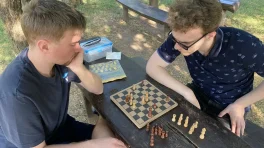
It means things you do for enjoyment alongside other people where you live. The idea is simple. You do something you like, in the company of other people.
The review does not say you need to join many groups or do anything demanding. Its point is that showing up in community life matters.
What you can do today
Pick one community activity near you and put a date for it on your calendar. Check the bulletin board or website of your public library, a senior center, or a local YMCA. If you are worried about someone else, share what you find and offer to go along the first time.
For clinicians and researchers
Design: Systematic review published in Nature Aging on social isolation, community leisure engagement and the social determinants of healthy aging in older adults. The abstract reports no sample size, number of studies, follow-up or comparator.
Main limitation: The abstract gives no search methods, included studies or quantitative synthesis. It states that lack of community leisure engagement has been neglected as a contributor to isolation and needs a broader conceptualization.
How it fits: Extends earlier Mongevity coverage of how being alone and feeling lonely affect the brain, and of overcoming loneliness, by adding community leisure engagement as a modifiable factor. Your social life and health: being alone and feeling lonely affect the brain differently · How can I overcome loneliness?
Open question: How community leisure engagement should be conceptualized and measured, and whether community participation and mobilization of community assets reduce social isolation and enhance healthy aging, remain to be tested.
Talk about it at home
Scientists did not run a new experiment this time. They gathered studies from many countries, a bit like putting together the pieces of a big puzzle, and the picture that appeared was that older people who spend more time with others tend to feel better and be healthier. They also noticed that joining activities in your own neighborhood is something people can actually choose to do.
Question for the table
Ask a grandparent or an older neighbor where people used to gather when they were young and what they loved doing together there. Does that place still exist, or did something new take its place?
Keep exploring
Copies this article and its questions so you can paste them into ChatGPT, Claude, Gemini or the AI you use, and keep the conversation going.
Cite this article
Mongevity Desk. Your social life and health: why community activities matter as you age. Mongevity. Published November 21, 2026. Accessed November 22, 2026. https://mongevity.science/lifestyle/2026/11/social-life-and-health-community-activities-older-adults/Mongevity Desk. Your social life and health: why community activities matter as you age [Internet]. Mongevity; 2026 Nov 21 cited 2026 Nov 22]. Available from: https://mongevity.science/lifestyle/2026/11/social-life-and-health-community-activities-older-adults/Mongevity Desk. (2026, November 21). Your social life and health: why community activities matter as you age. Mongevity. https://mongevity.science/lifestyle/2026/11/social-life-and-health-community-activities-older-adults/
<a href="https://mongevity.science/lifestyle/2026/11/social-life-and-health-community-activities-older-adults/">Your social life and health: why community activities matter as you age</a>
Free to share or quote with credit and a link.
Questions and answers
- What is social isolation?
- It means having little contact or connection with other people. The review links it to poorer health and well-being in older adults.
- Does joining a community activity fix isolation?
- The authors say community participation can help ease isolation and may support healthy aging. The review shows links, not a guarantee for any one person.
- Is this only a problem in the United States?
- No. Research from lower- and middle-income countries points the same way as research from higher-income ones, so the concern is global.
- Why focus on community leisure activities?
- The authors say a lack of engagement in them has been overlooked as a factor in isolation, and it is easier to change than many other factors.