CAR-T therapy for lymphoma worked longer when the product had more ‘young’ T cells
LymphomaPart of a story we are following · 2 articles · See every update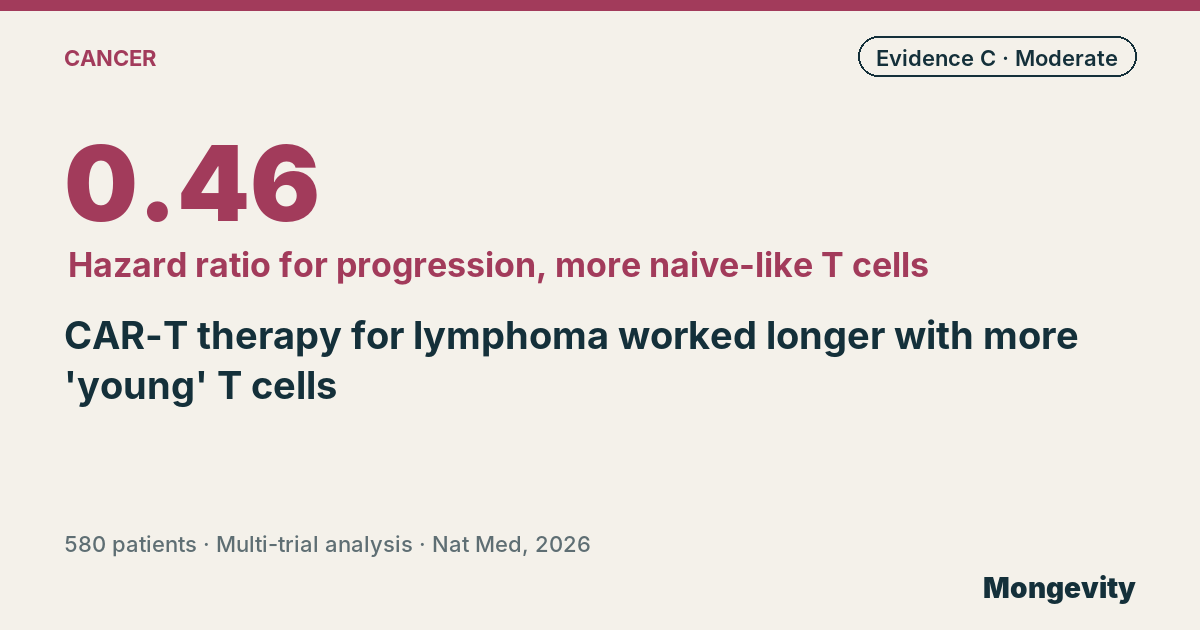
CAR-T products with more naive-like T cells were linked to longer progression-free survival (hazard ratio 0.46) in 580 people with lymphoma treated with axi-cel, in an analysis published Oct. 23, 2026, in Nature Medicine. It could help improve how these cell therapies are made.
CAR-T therapy takes a patient’s own T cells, engineers them in the lab to recognize cancer and infuses them back. Axicabtagene ciloleucel, or axi-cel, is a CAR-T therapy for non-Hodgkin lymphoma. It can lead to lasting remissions, but not in everyone.
What did the study do?
Researchers analyzed the T cell products given to 580 people with non-Hodgkin lymphoma across several clinical trials, with a median follow-up of 41.9 months. They examined the types of T cells in each product, along with tumor and clinical features, and checked their findings in an independent group of 203 patients.
What did the study find about lymphoma?
- A high proportion of naive-like T cells, “young” T cells that haven’t yet been activated, was the feature most strongly linked to longer progression-free survival, with a hazard ratio of 0.46 for high vs. low.
- This didn’t come with more side effects.
- The link held regardless of tumor environment and outperformed clinical features such as inflammation markers and tumor size.
- Patients who had received more prior treatments had fewer naive-like T cells, both in their product and in the blood collected to make it.
- Products with naive-like killer T cells that lacked exhaustion markers were linked to better outcomes.
Why does this matter?
The findings suggest CAR-T may work better when given earlier, before many rounds of chemotherapy wear down the T cells, and point to ways of improving how the products are made.
How solid is this evidence?
It’s moderate. Mongevity rates it C on our A-to-E scale: a large analysis across several trials with long follow-up and independent validation, but observational: the cell profiles weren’t assigned at random, so other differences between patients may play a role.
What are the open questions?
Trials need to test whether giving CAR-T earlier, or manufacturing products enriched in naive-like T cells, actually improves results.
What does this mean for you?
If you or someone close to you has lymphoma that came back or didn’t respond to treatment, ask the hematologist when CAR-T therapy might be considered, and whether earlier use could be an option.
How do I explain this at dinner?
CAR-T turns a patient’s own immune cells into cancer hunters. In people with lymphoma, the treatment kept working longer when the cells were “younger”, which tends to happen when they’re collected before many rounds of chemo. A good question for the table: why might fresher cells fight better?
In one sentence: in lymphoma treated with axi-cel, CAR-T products richer in naive-like T cells were linked to longer progression-free survival, supporting earlier use.
Questions and answers
- What is CAR-T therapy?
- A treatment that engineers a patient's own T cells to recognize and attack cancer.
- What predicted better results?
- More naive-like T cells in the product, with a hazard ratio of 0.46 for progression.
- Does timing matter?
- Patients with more prior treatments had fewer naive-like T cells, suggesting earlier use may help.