Adding immunotherapy and a targeted drug around bladder surgery helped people live longer
Bladder cancerPart of a story we are following · 2 articles · See every update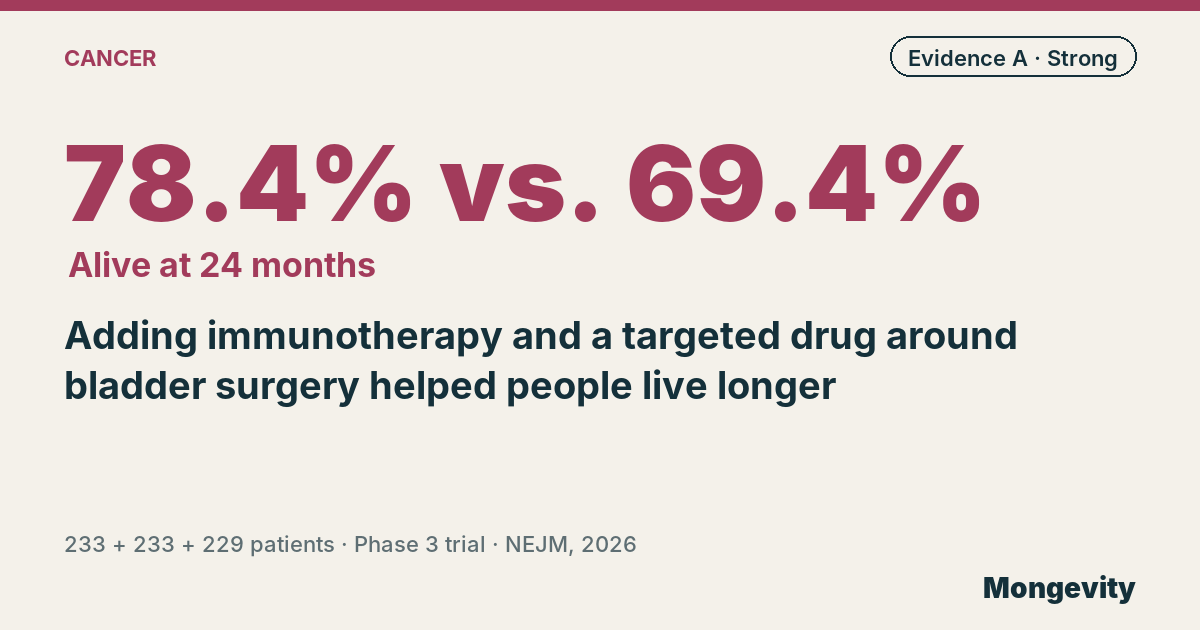
Adding durvalumab and enfortumab vedotin around surgery improved event-free and overall survival in people with muscle-invasive bladder cancer who couldn’t get cisplatin, in the VOLGA trial published Oct. 24, 2026, in New England Journal of Medicine. At 24 months, 78.4% were alive vs. 69.4% with surgery alone.
Muscle-invasive bladder cancer is usually treated by removing the bladder, a surgery called radical cystectomy, often with cisplatin chemotherapy first. But many people can’t receive cisplatin because of kidney problems or other conditions, or decline it.
What did the trial test?
People with muscle-invasive bladder cancer who couldn’t receive or declined cisplatin were assigned by chance to one of three groups:
- Durvalumab, an immunotherapy, plus enfortumab vedotin, an antibody-drug conjugate, for three cycles before surgery, then durvalumab after surgery (233 patients).
- The same plus a second immunotherapy, tremelimumab (233 patients).
- Surgery alone (229 patients).
What did the study find about bladder cancer?
| At 24 months | Durvalumab + enfortumab vedotin | Surgery alone |
|---|---|---|
| Alive without an event | 63.5% | 45.1% |
| Alive | 78.4% | 69.4% |
The hazard ratio for death was 0.58. The three-drug group also improved event-free survival (60.1% at 24 months), but serious side effects were more frequent. Grade 3 or higher adverse events occurred in 71.1% of the durvalumab-enfortumab vedotin group, 79.5% of the three-drug group and 50.2% with surgery alone.
Why does this matter?
For people who can’t get cisplatin, there was no proven treatment to add to surgery. This trial shows that a combination given before and after the operation can improve survival.
What questions remain?
Doctors will want to see mature overall survival data, longer follow-up on side effects and results in more diverse populations. They will also want to know how this option fits with other new treatments, and which patients benefit most, before it changes routine care everywhere.
How solid is this evidence?
It’s strong. Mongevity rates it A on our A-to-E scale: a randomized phase 3 trial with a survival benefit. Limits: it was open-label, side effects were frequent and it was funded by the drugmaker.
What does this mean for you?
If you or someone close to you has muscle-invasive bladder cancer and can’t receive cisplatin, ask whether perioperative immunotherapy combinations are an option. Blood in the urine should always be checked by a doctor. Not smoking lowers bladder cancer risk.
How do I explain this at dinner?
Some people with bladder cancer can’t get the usual chemo before surgery. Doctors tried an immune drug plus a targeted drug around the operation, and more people were alive two years later. A good question for the table: why might treating before surgery help?
In one sentence: in muscle-invasive bladder cancer without cisplatin, durvalumab plus enfortumab vedotin around surgery improved event-free and overall survival, with more serious side effects.
Questions and answers
- Who was this trial for?
- People with muscle-invasive bladder cancer who couldn't receive or declined cisplatin chemotherapy.
- Did it improve survival?
- Yes: 78.4% were alive at 24 months vs. 69.4% with surgery alone.
- What about side effects?
- Grade 3+ adverse events occurred in 71.1% with durvalumab-enfortumab vedotin vs. 50.2% with surgery alone.