A collagen-enriched diet didn’t ease arthritis in dogs more than a placebo diet
Arthritis in dogs and catsPart of a story we are following · 3 articles · See every update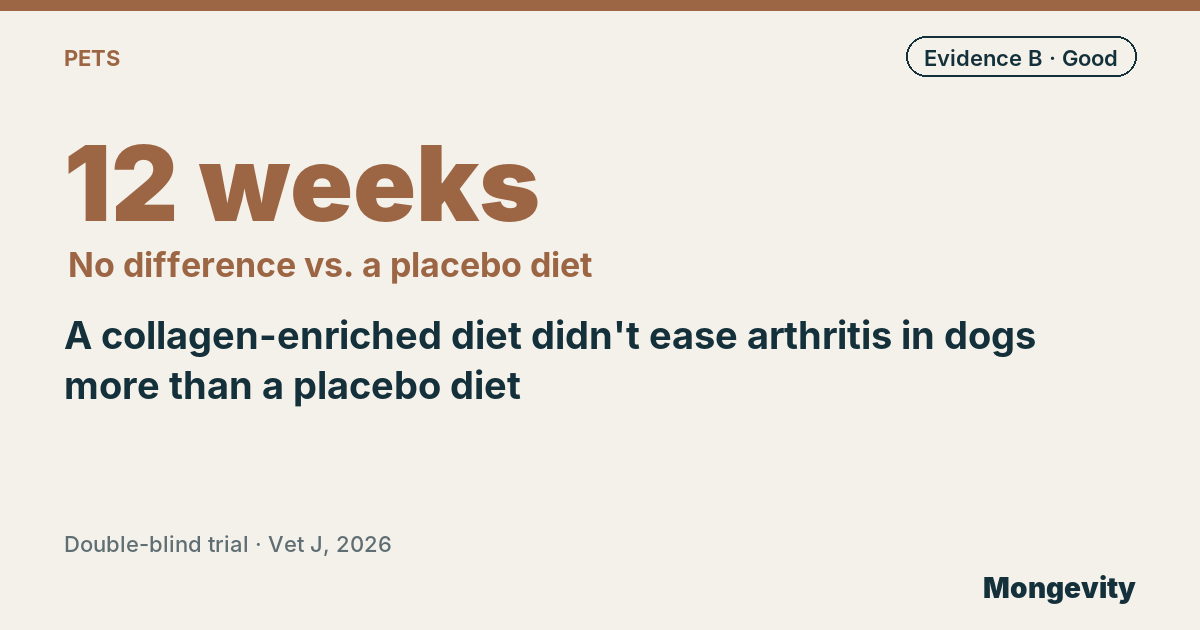
A diet enriched with collagen hydrolysate didn’t improve pain, function or gait in dogs with osteoarthritis over 12 weeks compared with a placebo diet, in a double-blind trial published Oct. 24, 2026, in The Veterinary Journal. Both groups seemed to improve, a reminder of the placebo effect in arthritis in pets.
Osteoarthritis is a common cause of chronic pain in dogs, especially as they age. Many owners try joint supplements and special diets, and collagen hydrolysate is a popular ingredient. Earlier studies hinted at benefits, but they had design problems.
What did the trial test?
Dogs with osteoarthritis confirmed on X-rays and mild signs were assigned by chance to a diet enriched with collagen hydrolysate or a placebo diet with the same calories, for 12 weeks. Neither owners nor researchers knew which. Owners filled in standard questionnaires about their dog’s pain and mobility, and the dogs’ walking was measured on a force plate, which records how much weight they put on each leg.
What did the study find about arthritis in pets?
- Forty-five dogs enrolled, and 9 dropped out, 3 of them for reasons related to arthritis or the food.
- Rescue pain medicine was used about equally: 5 of 17 dogs on collagen and 4 of 19 on placebo.
- There were no differences between groups in the pain questionnaires or in the gait analysis.
- Both groups seemed to improve, which the authors attribute to a caregiver placebo effect: owners who expect improvement tend to see it.
Why does this matter?
The placebo effect in pet owners is real and strong. Without a placebo group, it’s easy to believe a supplement works when it doesn’t. This trial is a reminder to look for controlled studies before paying for joint products.
How solid is this evidence?
It’s good. Mongevity rates it B on our A-to-E scale: a double-blind, placebo-controlled randomized trial with objective gait measurement. Limits: it was small, the dogs varied a lot, it lasted only 12 weeks and dogs had mild signs, so a benefit in other dogs or over longer periods can’t be ruled out.
What does this mean for you?
If your dog has arthritis, talk to your vet about treatments with stronger evidence: keeping a healthy weight, regular gentle exercise, physiotherapy and, when needed, pain medicines prescribed for dogs. If you try a supplement, track your dog’s mobility with your vet rather than by impression alone.
How do I explain this at dinner?
Owners fed arthritic dogs either a collagen-rich diet or a look-alike diet. Neither the owners nor the scientists knew which was which, and in the end the dogs in both groups seemed better, because owners expected it. A good question for the table: how do we know a treatment works and not just our hope?
In one sentence: a collagen hydrolysate-enriched diet didn’t improve osteoarthritis in dogs over 12 weeks compared with a placebo diet, and owners saw improvement in both.
Questions and answers
- Does collagen help dogs with arthritis?
- In this 12-week trial, a collagen-enriched diet didn't beat a placebo diet.
- Why did both groups improve?
- The authors point to a caregiver placebo effect: owners tend to see improvement they expect.
- What helps dogs with arthritis?
- Talk to your vet about weight control, gentle exercise, physiotherapy and pain medicines made for dogs.